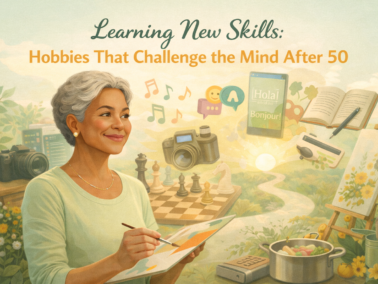
You remember the moment, don't you?
Maybe it was watching someone play the piano at a dinner party — fingers moving with an ease that looked like magic — and feeling that quiet, wistful pull: "I always wanted to learn that."
Maybe it was overhearing a conversation in Italian on a cobblestoned street in Florence, and feeling the sudden, sharp awareness of a whole world of meaning you couldn't access.
Maybe it was standing in front of a painting in a gallery — really standing in front of it, the way you rarely do — and thinking: "I wonder if I could ever make something like that."
And then — almost immediately — the other voice. The practical one. The one that has been running the show for decades.
"You're too old to start that now."
"You'd never be good enough."
"That ship has sailed."
If that voice sounds familiar, this post is for you.
Because here is what the neuroscience says — unambiguously, repeatedly, and with growing excitement: that voice is wrong.
Not slightly wrong. Not wrong-but-understandable. Categorically, demonstrably, scientifically wrong.
Your brain — right now, at whatever age you are reading this — retains a remarkable, lifelong capacity to learn, grow, and change. To form new neural connections. To build new skills. To surprise you. The idea that the brain is fixed after a certain age — that the "learning years" are behind you — is one of the most thoroughly debunked myths in modern neuroscience. And yet it persists, quietly stealing the learning lives of millions of women who could be playing the piano, speaking Italian, painting, dancing, writing, coding, and growing in ways they have never imagined.
Here is the counterintuitive truth that changes everything: the brain doesn't decline because we age. It declines because we stop challenging it.
And here is the truth that follows from that: learning a new skill after 50 is not just a hobby. It is one of the most powerful acts of self-care available to you.
In this post, we're going to cover everything you need to know: the neuroscience of what's actually happening in your brain when you learn something new, why learning is especially powerful after 50, ten mind-challenging hobbies backed by research, how to choose the right one for you, a complete weekly learning schedule, and how it all connects to your four pillars of holistic well-being.
Your brain is not finished with you yet. Let's begin. 📚💛
What's Actually Happening in Your Brain When You Learn Something New
Before we get to the hobbies, let's talk about what's actually happening inside your brain when you pick up a new skill — because understanding the biology makes the whole thing feel less like a luxury and more like the essential self-care it truly is.
Neuroplasticity — Your Brain's Lifelong Superpower
For most of the twentieth century, the scientific consensus was that the adult brain was essentially fixed — that after a certain developmental window closed, the brain's structure was set, and that was that. Learning was possible, yes, but the underlying architecture of the brain was considered immutable.
That consensus has been completely overturned.
The modern neuroscience of neuroplasticity — the brain's ability to reorganise itself by forming new neural connections throughout life — has transformed our understanding of what the ageing brain is capable of. And the findings are extraordinary.
Every time you learn something new, your brain physically changes. New synaptic connections form between neurons. Existing connections strengthen. The myelin sheath around frequently used neural pathways thickens — making signal transmission faster and more efficient. In some regions of the brain — particularly the hippocampus, the brain's memory centre — entirely new neurons are generated through a process called neurogenesis. [1][2]
This is not a metaphor. This is measurable, observable, physical change in the structure of your brain — happening right now, in response to every new challenge you give it.
The key principle, articulated by neuroscientist Donald Hebb in what has become one of the most famous phrases in neuroscience: "Neurons that fire together, wire together." Every time you practice a new skill, the neural pathway associated with that skill fires. Every time it fires, the connection strengthens. Every repetition is a physical investment in the architecture of your brain. [1][2][3]
And this process — this remarkable, life-affirming process — does not stop at 50. Or 60. Or 70. Or beyond. Neuroplasticity continues until the very end of life. The brain you have today is not the brain you will have in six months if you give it something genuinely new to learn. [1][2]
What Actually Changes in the Ageing Brain — and What Doesn't
Let's be honest about what does change with age — because the empowering truth is not that nothing changes, but that what changes is far less significant than what doesn't.
What slows: Processing speed — the raw speed at which the brain processes new information — does gradually decrease with age. Working memory — the ability to hold and manipulate information in the short term — also changes. These are real, measurable changes. [1][2]
What grows: Crystallised intelligence — the accumulated knowledge, wisdom, vocabulary, and pattern recognition built over a lifetime — actually peaks after 50 and continues to grow well into the 60s and 70s. Emotional intelligence increases. The ability to see the big picture, to integrate complex information, to understand nuance and context — all of these improve with age. [1][2][3]
The critical distinction: There is a profound difference between normal cognitive ageing — the gradual, modest changes described above — and pathological cognitive decline, which is driven by disease, inactivity, chronic stress, poor nutrition, and social isolation. Most of what women over 50 fear about their cognitive future is not inevitable ageing — it is preventable decline. And learning new skills is one of the most powerful preventive tools available. [1][2]
Cognitive Reserve — Building Your Brain's Protective Buffer
One of the most important concepts in brain health research is cognitive reserve — the brain's resilience against damage and decline, built through education, mental stimulation, social engagement, and lifelong learning.
Think of cognitive reserve as your brain's savings account. Every intellectually challenging activity you engage in makes a deposit. The larger your reserve, the more resilience your brain has against the effects of ageing and disease — the more damage it can sustain before symptoms appear.
The evidence for cognitive reserve is remarkable. In the landmark Nun Study — one of the most famous longitudinal studies in neuroscience — researchers found that many nuns whose brains showed the physical hallmarks of advanced Alzheimer's disease at autopsy had shown no cognitive symptoms during their lifetimes. The explanation? Decades of intellectually stimulating activity had built sufficient cognitive reserve to compensate for the physical damage. [1][2][3]
The practical implication is profound: the cognitive challenges you take on today are building the reserve that will protect your brain for decades to come. Every new skill you learn is an investment with a long-term return.
BDNF — The Brain's Growth Hormone
Here is the biological mechanism that makes learning so powerful for long-term brain health: Brain-Derived Neurotrophic Factor, or BDNF.
BDNF is a protein that promotes the growth, survival, and connection of neurons — often described as "Miracle-Gro for the brain." It is the primary biological driver of neuroplasticity, and its production is directly stimulated by learning new skills, physical exercise, quality sleep, and social connection. [1][2][3]
Low BDNF levels are associated with cognitive decline, depression, and increased Alzheimer's risk. High BDNF levels are associated with better memory, faster learning, greater cognitive resilience, and improved mood. And one of the most reliable ways to increase BDNF is to give your brain something genuinely new and challenging to learn.
When you sit down to practice a new instrument, or work through a language lesson, or figure out a chess strategy you've never tried before — you are not just learning a skill. You are flooding your brain with the growth hormone it needs to stay healthy, resilient, and sharp. [1][2]
The Novelty Principle — Why New Skills Beat Familiar Activities
This is the insight that changes how you think about cognitive challenge — and it is one of the most important in this entire post.
The brain habituates to familiar activities. Once you have mastered a crossword puzzle, a sudoku grid, or a familiar card game, the cognitive benefit diminishes dramatically. The brain has built the neural pathways required for that activity — and now it runs them on autopilot, with minimal effort and minimal growth. [1][2][3]
True cognitive benefit requires genuine novelty and challenge — activities that push the edges of your current ability, that require your brain to build new pathways rather than run existing ones. The research is clear: activities that are new, complex, and socially engaging produce the greatest cognitive benefits. [2][3]
And here is the insight that reframes everything: the discomfort of learning something new IS the benefit. That feeling of confusion, of fumbling, of not quite getting it yet — that is the feeling of your brain working hard to build new connections. That is neuroplasticity in action. That is growth.
The discomfort is not a sign that you're doing it wrong. It is a sign that you're doing it exactly right.
The Five Cognitive Domains That New Skills Strengthen
Different hobbies challenge different aspects of cognitive function. Here's a quick overview of the five key domains — and why each matters for your long-term brain health:
| Cognitive Domain | What It Is | Why It Matters | Skills That Target It |
|---|---|---|---|
| Executive Function | Planning, decision-making, cognitive flexibility | The brain's CEO — organises and directs all other cognitive processes | Chess, coding, cooking, gardening |
| Processing Speed | How quickly the brain processes and responds | Affects reaction time, learning speed, and daily efficiency | Music, dance, chess |
| Working Memory | Holding and manipulating information short-term | Essential for learning, conversation, and complex tasks | Language learning, music, dance |
| Attention & Focus | Sustained, selective, and divided attention | The foundation of all learning and productivity | Photography, visual arts, writing |
| Visuospatial Processing | Understanding and navigating spatial relationships | Navigation, art, architecture, and physical coordination | Visual arts, photography, dance |
Why Learning New Skills Is Especially Powerful After 50
The neuroscience applies at every age — but there are specific reasons why learning new skills is particularly powerful, particularly meaningful, and particularly well-timed for women in their 50s and beyond.
The Post-50 Brain — Unique Strengths You May Not Realise You Have
Here is something the "you're too old to learn" narrative never tells you: the post-50 brain has genuine cognitive advantages that younger brains don't.
Crystallised intelligence — the accumulated knowledge, vocabulary, pattern recognition, and wisdom built over decades of living — peaks after 50. You bring to any new learning endeavour a richness of context, a depth of life experience, and a sophistication of understanding that a 25-year-old simply doesn't have. When you learn a new language at 55, you bring a lifetime of linguistic awareness. When you learn to paint at 60, you bring decades of aesthetic experience. When you learn chess at 58, you bring a lifetime of strategic thinking. [1][2]
You also bring something equally valuable: freedom. The freedom to learn for pure joy, without grades, without career pressure, without anyone evaluating your performance. The freedom to be a genuine beginner — curious, open, unhurried. Many women describe this as one of the most liberating aspects of learning in their 50s: the permission to be imperfect, to fumble, to delight in the process rather than fixate on the outcome.
The Research on Lifelong Learning and Cognitive Longevity
The evidence is compelling and consistent:
The landmark Rush Memory and Aging Project — following over 1,600 older adults for more than two decades — found that cognitively active adults show 32% slower cognitive decline than their less active counterparts. [1][2]
A landmark 2014 University of Texas study by Denise Park and colleagues found that learning complex new skills — specifically photography and quilting — produced significant memory improvements in older adults, significantly greater than passive activities like listening to music or doing familiar puzzles. The key factor: genuine novelty and complexity. [2][3]
The Mayo Clinic Study of Aging found that mentally stimulating activities — particularly those involving learning new skills — reduce dementia risk by up to 63%. [1][2]
And the social dimension matters enormously: group learning environments provide cognitive AND social benefits simultaneously — and socially engaged older adults show up to 70% less cognitive decline than socially isolated ones. [2][3]
The Emotional and Psychological Benefits
Beyond the neuroscience, there is something profoundly important about learning a new skill after 50 that the research captures imperfectly: the feeling of becoming.
The satisfaction of mastery — of playing a piece of music you couldn't play last month, of having a conversation in a language you didn't speak last year, of looking at a painting you made and feeling genuine pride — is one of the most nourishing emotional experiences available. It restores a sense of identity and purpose that many women find diminished after the career and caregiving roles that defined their earlier decades begin to shift.
Psychologist Mihaly Csikszentmihalyi's concept of flow — the state of complete absorption in a challenging, meaningful activity — is one of the most reliable predictors of well-being and life satisfaction. And new skill learning is one of the most reliable pathways to flow. When you are genuinely absorbed in learning something that matters to you, time disappears, self-consciousness dissolves, and you are simply, completely, joyfully present. [1][2]
This is not a small thing. This is one of the most important things. And it connects directly to everything we explored in our post on [Finding Purpose and Meaning in Your 50s] — because learning a new skill is, at its heart, an act of becoming. And becoming never has an age limit.
Ten Mind-Challenging Hobbies for Women Over 50
Now — the heart of it. Ten hobbies that the research consistently identifies as among the most cognitively beneficial available. You don't need to try all ten. You need to find the one — or the two, or the three — that genuinely call to you. Because the best cognitive hobby is the one you love enough to practice consistently.
🎵 Hobby 1 — Learning a Musical Instrument
If there is one hobby that neuroscientists would prescribe for brain health above all others, it is this one.
Learning a musical instrument is the most cognitively demanding hobby available — and the research behind it is extraordinary. Playing music simultaneously engages motor skills (both hands doing different things), auditory processing (listening and adjusting in real time), memory (learning pieces, scales, theory), pattern recognition (musical structure), emotional processing (music is one of the most emotionally rich human experiences), and executive function (coordinating all of the above simultaneously). No other single activity engages this many cognitive domains at once. [1][2][3]
The research confirms what this complexity suggests: musicians show significantly larger grey matter volume in multiple brain regions, including the motor cortex, auditory cortex, and cerebellum. And — crucially — learning an instrument in later life produces measurable cognitive improvements within months, even in adults who have never played before. [1][2]
Best instruments for beginners over 50: The piano or keyboard is widely considered the most accessible starting point — the visual layout of the keys makes music theory intuitive, and the immediate feedback of pressing a key and hearing a note is deeply satisfying. The ukulele is gentle on fingers, quick to produce recognisable sounds, and enormously joyful. The guitar has the widest repertoire and the most teaching resources available. And singing — often overlooked — is the most accessible instrument of all, always with you, and one of the most socially rich musical experiences available.
Getting started: Local music schools, Simply Piano or Fender Play apps, YouTube tutorials, community choirs. Even 15–20 minutes of daily practice produces measurable progress within four to six weeks.
The social dimension: Community orchestras, choirs, jam sessions, and duet partnerships offer some of the most cognitively and emotionally rich social experiences available.
🌍 Hobby 2 — Learning a New Language
Language learning is one of the most extensively researched cognitive interventions in the literature — and the findings are among the most dramatic in all of brain health research.
Bilingualism and active language learning produce measurable increases in grey matter density, executive function, and cognitive reserve. The brain regions most engaged by language learning — the prefrontal cortex, the anterior cingulate cortex, the hippocampus — are precisely the regions most vulnerable to age-related decline. Language learning is, in a very real sense, targeted exercise for the brain's most important structures. [1][2][3]
And the most dramatic finding: bilingual adults develop Alzheimer's symptoms an average of four to five years later than monolingual adults — the most powerful single demonstration of cognitive reserve in the entire literature. Four to five years. From learning a language. [1][2]
Best languages for English speakers to start: Spanish is the most widely spoken and has the most abundant learning resources. French is beautiful, widely taught, and opens an extraordinary cultural world. Italian is musical, accessible, and deeply connected to art, food, and history. Japanese — for the adventurous — offers a completely different linguistic structure that provides maximum cognitive challenge and the most dramatic neuroplasticity stimulus.
Getting started: Duolingo (free, gamified, 10–15 minutes daily — the most accessible entry point), Babbel (structured and research-backed), iTalki (conversation practice with native speakers), local language classes (the social dimension amplifies the cognitive benefit).
Realistic expectations: Conversational competence in a closely related language (Spanish, French, Italian) within six to twelve months of consistent daily practice. The journey is as valuable as the destination.
🎨 Hobby 3 — Visual Arts: Painting, Drawing, and Printmaking
Visual art is a cognitive workout disguised as one of life's great pleasures.
Creating visual art engages visuospatial processing, fine motor skills, creative problem-solving, sustained attention, and the deep observational skills that sharpen perception across all areas of life. The act of truly looking — really seeing the light on a surface, the relationship between shapes, the way colour changes in shadow — develops a quality of attention that transforms not just your art but your entire experience of the world. [1][2][3]
The research confirms significant benefits: regular engagement with visual arts reduces dementia risk, improves mood, reduces anxiety, and produces measurable improvements in problem-solving and creative thinking. And the process itself — the absorption, the problem-solving, the making — is one of the most reliable pathways to the flow state that Csikszentmihalyi identifies as central to well-being. [2][3]
Options to explore: Watercolour painting is forgiving, beautiful, and wonderfully portable — a sketchbook and a small watercolour set can go anywhere. Oil painting is rich, traditional, and deeply satisfying — the slow drying time allows for endless revision and refinement. Sketching and drawing is the foundation of all visual art and requires nothing more than a pencil and a notebook. Linocut printmaking is tactile, graphic, and endlessly creative. Digital art is accessible, requires no physical materials, and opens an enormous creative range.
Getting started: Local art classes, community art centres, Skillshare or Domestika online courses, YouTube tutorials. The social dimension of an art class — the shared creative struggle, the mutual encouragement — is as valuable as the instruction.
✍️ Hobby 4 — Creative Writing and Storytelling
Writing is thinking made visible — and it is one of the most cognitively rich activities available.
Creative writing engages language processing, memory retrieval, narrative construction, emotional processing, and the executive function required to organise complex ideas into coherent, meaningful expression. It is simultaneously a cognitive workout and a profound act of self-exploration. [1][2][3]
The research on expressive writing is particularly compelling: regular writing reduces stress, improves immune function, enhances emotional processing, and produces measurable improvements in working memory and cognitive flexibility. And for women over 50, the specific practice of life writing and memoir — telling the stories of your own life — is one of the most powerful tools available for meaning-making, identity integration, and the kind of narrative coherence that psychologists associate with psychological well-being and resilience. [2][3]
Forms to explore: Personal memoir and life writing is the most natural starting point for women over 50 — you have a lifetime of extraordinary material. Short story writing is more accessible than the novel many women dream of writing. Poetry is the most concentrated form of language — and the most forgiving of imperfection. Journaling is the most accessible daily practice — and the one with the most robust research support. Blogging combines writing with community, purpose, and the particular satisfaction of sharing your voice with the world.
Getting started: Local writing groups (the accountability and community are invaluable), online courses on Coursera or MasterClass, the 750words.com daily writing practice, or simply a beautiful notebook and the commitment to fill ten minutes of it every day.
The minimum effective dose: Write something — anything — every day. Even ten minutes. The practice is the point.
♟️ Hobby 5 — Chess and Strategic Board Games
Chess is one of the most direct cognitive training tools available — and one of the most extensively researched.
Playing chess requires planning and forward thinking (executive function), pattern recognition (identifying threats and opportunities across the board), working memory (holding multiple lines of play in mind simultaneously), strategic thinking (balancing short-term tactics with long-term strategy), and the emotional regulation required to remain calm and focused under pressure. It is, in many ways, a complete cognitive workout in a single activity. [1][2][3]
The research is compelling: regular chess players show significantly better executive function, processing speed, and working memory than non-players. Multiple longitudinal studies have found associations between regular chess play and reduced dementia risk. And the social dimension of chess — clubs, tournaments, online communities — provides the additional cognitive and emotional benefits of social engagement. [2][3]
Beyond chess: Go — the ancient Chinese strategy game — is considered the most complex strategy game ever devised, and offers even greater cognitive challenge than chess. Bridge is exceptional for working memory and social connection — and has one of the most robust research bases of any card game for cognitive health. Scrabble combines language and strategy beautifully. Modern strategy board games like Settlers of Catan and Ticket to Ride offer strategic thinking in a wonderfully social context.
Getting started: Chess.com is free, comprehensive, and offers lessons and games at every level. Local chess clubs, board game cafés, and family game nights are all excellent entry points. The learning curve is steep — and that is precisely the point.
💻 Hobby 6 — Coding and Digital Skills
This one surprises many women — but the research is unambiguous, and the cognitive benefits are exceptional.
Learning to code is one of the most cognitively demanding activities available — requiring logical thinking, pattern recognition, abstract reasoning, systematic problem-solving, and the ability to hold complex systems in mind simultaneously. It engages the prefrontal cortex — the brain's executive centre — more intensively than almost any other activity. [1][2][3]
Research on coding education in older adults shows significant improvements in executive function, processing speed, and working memory — comparable to the most effective cognitive training programmes available. And unlike many cognitive training tools, coding has immediate practical value: you can build things, automate tasks, create websites, and solve real problems with the skills you develop. [2][3]
Accessible entry points: Python is widely considered the most beginner-friendly programming language — its syntax is clean, its applications are enormous, and the learning community is exceptionally welcoming. HTML and CSS — the languages of the web — allow you to build simple websites within weeks. No-code tools like Squarespace, Notion, and Canva offer the problem-solving satisfaction of digital creation without traditional programming. Digital photo editing in Lightroom or Photoshop is a technical skill with immediate creative application.
Getting started: Code.org (free, genuinely beginner-friendly), Codecademy (structured and interactive), freeCodeCamp (free and comprehensive), local digital skills workshops at libraries and community centres.
🌱 Hobby 7 — Gardening and Botanical Knowledge
Gardening is one of the most underrated cognitive activities available — and one of the most holistically nourishing.
The cognitive demands of gardening are more substantial than they appear: garden design and planning engage executive function and spatial reasoning; understanding plant biology, soil science, and ecology engages scientific knowledge and systems thinking; pest management and plant health require ongoing problem-solving; and the close, sustained observation of living systems develops a quality of attention that enriches every area of life. [1][2][3]
The research is remarkable: gardening reduces dementia risk by up to 36% in longitudinal studies — one of the largest effect sizes of any leisure activity studied. It reduces cortisol, improves mood, and produces measurable improvements in attention and cognitive function. [2][3]
And there is a biological bonus that most people don't know about: exposure to soil bacteria — specifically Mycobacterium vaccae — has been shown to increase serotonin production and improve mood. Gardening is, quite literally, antidepressant. Getting your hands in the soil is not just pleasant — it is biochemically beneficial.
Forms to explore: Vegetable and herb gardening offers immediate practical reward — the satisfaction of eating what you grow is profound. Flower gardening is aesthetic, seasonal, and endlessly creative. Container gardening makes the practice accessible for limited spaces. Botanical illustration — combining close observation of plants with drawing — is one of the most cognitively rich combinations available.
The social dimension: Gardening clubs, community gardens, allotments, seed swaps, and plant fairs are among the most welcoming communities available — and the intergenerational knowledge-sharing that happens in these spaces is a cognitive and social treasure.
📷 Hobby 8 — Photography and Visual Storytelling
Photography is a cognitive activity disguised as a creative one — and the research behind it is particularly compelling.
Creating photographs develops sustained attention (the discipline of truly looking), visuospatial processing (understanding light, composition, and spatial relationships), technical knowledge (exposure, focus, editing), aesthetic judgment (the cultivation of a visual sensibility), and the narrative thinking required to tell stories through images. It is a uniquely rich cognitive combination. [1][2][3]
And the research is specific: the landmark 2014 University of Texas study by Denise Park — the most rigorous study of cognitive hobbies in older adults — specifically identified photography as one of the activities producing the most significant memory improvements. More than listening to music. More than doing word games. More than watching educational videos. The key factor: the genuine novelty and complexity of learning to see and capture the world in a new way. [2][3]
Forms to explore: Digital photography offers immediate feedback and enormous creative range. Film photography is slower, more intentional, and deeply satisfying in its deliberateness. Smartphone photography is always with you — and the constraint of a single lens is creatively liberating. Photo editing in Lightroom or VSCO adds a technical and aesthetic dimension. Photo books and storytelling projects give your images narrative purpose.
Getting started: Local photography clubs, online courses on Skillshare or CreativeLive, photography walks, photo-a-day challenges. The social dimension of a photography club — the shared looking, the mutual critique, the collective delight in the world's visual richness — is as valuable as the technical instruction.
🍳 Hobby 9 — Cooking and Culinary Arts
Cooking is one of the most cognitively holistic activities available — and one of the most immediately rewarding.
The cognitive demands of cooking are genuinely substantial: planning and sequencing a meal engages executive function; measurement and proportion engage mathematical reasoning; understanding the chemistry of cooking (why bread rises, why sauces emulsify, why meat browns) engages scientific thinking; sensory discrimination — developing a refined palate for taste, smell, and texture — engages perceptual processing; and the cultural knowledge embedded in cuisines from around the world opens an entire dimension of historical and anthropological learning. [1][2][3]
Research consistently associates regular cooking with better cognitive function, greater nutritional quality, improved mood, and stronger social connections. And the nutritional dimension is directly relevant to brain health: learning to cook anti-inflammatory, brain-healthy meals is simultaneously a cognitive challenge AND a direct investment in the neurological health that makes all other cognitive activities possible. [2][3]
Forms to explore: Learning a new cuisine — Japanese, Indian, Mexican, Middle Eastern — opens a world of flavour, technique, and cultural knowledge. Bread and pastry making combines precision, chemistry, and the deeply satisfying alchemy of transforming simple ingredients into something extraordinary. Fermentation — sourdough, kombucha, kimchi — is science, craft, and patience in beautiful combination. Food photography and styling adds a visual creative dimension. Hosting and entertaining as a creative practice brings the social dimension that amplifies every cognitive benefit.
Getting started: Local cooking classes, MasterClass (world-class chefs teaching their craft), YouTube (an inexhaustible free resource), and cookbooks — which are, themselves, a wonderful reading practice.
💃 Hobby 10 — Dance and Movement Arts
We saved perhaps the most joyful for last — and the research behind it is the most dramatic of all.
Dance is the only activity that simultaneously engages physical movement, music processing, social interaction, memory (learning and remembering sequences), and spatial awareness — making it the most cognitively comprehensive single activity available. It is a full-brain workout wrapped in music and human connection. [1][2][3]
And the landmark research: the famous 2003 New England Journal of Medicine study by Joe Verghese and colleagues — one of the most cited studies in cognitive ageing research — found that dancing was the only physical activity associated with a reduced risk of dementia. Not swimming. Not cycling. Not tennis. Dancing. The researchers attributed this to the unique combination of physical, musical, social, and memory demands that dance places on the brain simultaneously. [1][2]
Forms to explore: Ballroom dancing — waltz, foxtrot, tango — is structured, social, and elegantly beautiful. Latin dancing — salsa, cha-cha, bachata — is joyful, energetic, and wonderfully social. Folk and line dancing is accessible, community-oriented, and deeply rooted in cultural tradition. Contemporary dance is expressive, creative, and liberating. Online dance classes make every style accessible from your living room.
Getting started: Local dance studios, community centres, online platforms like YouTube or Steezy, social dance events. Basic social dance competence within eight to twelve weeks — and the joy of the process is immediate, from the very first lesson.
How to Choose the Right Hobby for Your Brain
With ten options in front of you, how do you choose? Here are the four criteria that the research identifies as most important for cognitive benefit — and a practical framework for finding your best match.
The Four Criteria for Maximum Cognitive Benefit
Novelty: Is it genuinely new to you? The brain benefits most from activities outside its current repertoire. If you've been painting for twenty years, painting is no longer novel — but learning a language might be.
Challenge: Does it push the edges of your current ability? Comfortable activities produce minimal cognitive benefit. The sweet spot is the edge of your competence — challenging enough to require effort, accessible enough to produce progress.
Complexity: Does it engage multiple cognitive domains simultaneously? Multi-domain activities — music, dance, language learning — produce greater cognitive benefits than single-domain ones.
Enjoyment: Will you actually do it consistently? This is the most important criterion of all. The best cognitive hobby is the one you love enough to practice regularly — because consistency is the variable that determines everything.
Matching Hobbies to Your Cognitive Goals
| Cognitive Goal | Best Hobbies | Why |
|---|---|---|
| Memory improvement | Music, language learning, dance | All require memorisation of sequences, vocabulary, or choreography |
| Executive function | Chess, coding, cooking | All require planning, sequencing, and strategic decision-making |
| Creative thinking | Visual arts, writing, photography | All require original problem-solving and aesthetic judgment |
| Processing speed | Music, dance, chess | All require rapid pattern recognition and real-time response |
| Emotional well-being | Writing, gardening, cooking, dance | All provide flow, mastery, and social connection |
| Social connection | Dance, chess/board games, choir | All are inherently social and community-building |
The Beginner's Mind — Embracing Not Knowing
In Zen Buddhism, there is a concept called Shoshin — the beginner's mind. It describes the quality of approaching any experience with openness, eagerness, and freedom from preconceptions — the way a child approaches the world, before expertise and habit narrow the field of possibility.
The beginner's mind is not just a philosophical ideal. It is a neurological state — the state in which the brain is most plastic, most receptive, most actively building new connections. And it is available to you, right now, in relation to any skill you have not yet learned.
The discomfort of not knowing — the fumbling, the confusion, the gap between what you can hear in your head and what your hands can produce — is not a problem to be solved. It is the experience of neuroplasticity. It is the feeling of your brain growing. Reframe it as such, and it becomes not frustrating but fascinating.
Psychologist Carol Dweck's research on the growth mindset — the belief that abilities can be developed through dedication and hard work — is directly applicable here. Women with a growth mindset approach new skills with curiosity rather than anxiety, persist through difficulty rather than retreating from it, and ultimately achieve significantly greater learning outcomes than those with a fixed mindset. The good news: the growth mindset itself can be learned. And learning it is, itself, a cognitive challenge worth taking on. [1][2]
Starting Small — The Minimum Effective Dose
Here is the most liberating finding in the research on cognitive hobbies: 15–20 minutes of focused, intentional practice daily produces measurable cognitive benefits. You do not need hours. You do not need a studio, a classroom, or expensive equipment. You need fifteen minutes and genuine attention. [1][2][3]
The compound effect of consistent small practice is extraordinary. Fifteen minutes daily is 91 hours in a year — enough to develop genuine competence in almost any skill. And the habit-stacking approach — attaching your new skill practice to an existing daily habit (morning coffee, lunch break, evening wind-down) — makes consistency dramatically more achievable.
The 30-day commitment: Give any new hobby at least 30 days before evaluating whether it's right for you. The first two weeks of any new skill are the most cognitively demanding and the least immediately rewarding — the brain is building the foundational pathways, and progress feels slow. By week three or four, something shifts. The pathways begin to consolidate. Progress becomes visible. The activity begins to feel less like effort and more like pleasure. Give it 30 days. [1][2]
Your Personal Weekly Learning Schedule
Here is a complete, practical weekly schedule that weaves cognitive hobby practice into a balanced, sustainable routine. Adapt it freely — the structure matters less than the consistency.
| Day | Morning Practice (15 min) | Main Learning Session (30–60 min) | Evening Reflection (10 min) |
|---|---|---|---|
| Monday | Language app (Duolingo/Babbel) | Music practice — instrument or singing | Journal: what did I learn today? |
| Tuesday | Photography walk or mindful observation | Online art class or painting/drawing practice | Read about your chosen hobby |
| Wednesday | Language app | Chess online or strategy game | Creative writing — 10 minutes, any form |
| Thursday | Recipe research and planning | Cooking class or new recipe exploration | Reflect on techniques and discoveries |
| Friday | Language app | Dance class or video — any style | Weekly learning journal — what grew this week? |
| Saturday | Garden planning or nature walk | Gardening or hobby deep-dive session | Social hobby activity — club, class, or group |
| Sunday | Gentle review of week's learning | Free exploration — follow your curiosity | Set intentions for next week's learning |
The Daily Non-Negotiables
If the full schedule feels overwhelming, start with just these two practices — done every day, they produce measurable cognitive benefits within four to six weeks:
1. Fifteen minutes of language learning — the most accessible, most researched, most consistently beneficial daily cognitive challenge available. Duolingo makes it free, gamified, and genuinely enjoyable.
2. Ten minutes of journaling — consolidates the day's learning, builds narrative intelligence, processes experience, and develops the reflective self-awareness that makes all other learning more effective.
These two practices. Every day. That is your minimum effective dose.
Tracking Your Cognitive Progress
Progress with cognitive hobbies is often gradual — and easy to miss if you're not paying attention. Track these markers:
- Skill milestones: First song learned. First conversation in your new language. First completed painting. First chess game won. These are concrete, celebratable evidence of neural pathway formation.
- Subjective markers: Mental clarity, focus, memory confidence, learning speed — do you feel sharper? More engaged? More curious?
- The learning journal: Document what you're learning, what's challenging, what's clicking, what surprises you. The journal is both a tracking tool and a cognitive practice in itself.
- Celebrate milestones: The dopamine reward of acknowledged achievement is not trivial — it is the neurochemical signal that reinforces the behaviour and makes you want to continue. Celebrate every milestone, however small.
The Social Dimension — Why You Shouldn't Learn Alone
The cognitive benefits of new skill learning are significant. The cognitive benefits of new skill learning in a social context are even greater — and the research on this point is unambiguous.
Social interaction is independently associated with reduced dementia risk — separate from the cognitive activity itself. The mental stimulation of other minds, the accountability of shared commitment, the emotional warmth of community — all of these amplify the cognitive benefits of any learning activity. [1][2][3]
And the numbers are striking: socially engaged older adults show up to 70% less cognitive decline than socially isolated ones. Seventy percent. Social connection is not a nice-to-have for brain health. It is a biological necessity. [2][3]
Finding your learning community: Local community colleges, adult education centres, arts centres, and libraries offer an extraordinary range of classes and groups — many free or low-cost. Online platforms like Coursera, MasterClass, and Skillshare offer structured learning with community forums. Language exchange platforms like Tandem and iTalki connect you with native speakers around the world. And there is always the option of creating your own — a painting circle, a cooking club, a language exchange group, a book club that reads in your target language.
The intergenerational dimension: Learning alongside younger people — in a dance class, a coding workshop, a photography group — offers mutual benefit and perspective that is cognitively and emotionally enriching for everyone involved. Don't shy away from mixed-age learning environments. You bring something to them that younger learners genuinely need.
Teaching as the deepest form of learning: The Protégé Effect — the well-documented finding that teaching what you know consolidates and deepens your own understanding — is one of the most powerful learning tools available. Once you have developed some competence in a new skill, look for opportunities to share it: community workshops, online tutorials, mentoring, teaching family members. The act of explaining what you know forces you to understand it more deeply — and the satisfaction of sharing knowledge connects directly to the sense of purpose and meaning we explored in [Finding Purpose and Meaning in Your 50s].
Learning New Skills and Your Four Pillars of Well-Being
One of the things I love most about cognitive hobbies is how completely they nourish every dimension of your well-being — not just the intellectual. Let's look at how learning new skills connects to each of your four pillars.
💪 Physical Well-Being
Many of the most cognitively beneficial hobbies are also physically active — dance, gardening, photography walks, cooking. And the connection runs deeper than the activities themselves: physical exercise is one of the most powerful amplifiers of the cognitive benefits of learning, through its effect on BDNF production. The brain that is physically active learns faster, retains more, and builds cognitive reserve more efficiently than the sedentary brain.
For the complete physical well-being picture, see our posts on [Gentle Movement Routines for Joint Health], [Strength Training to Combat Age-Related Muscle Loss], and [Essential Health Screenings for Women Over 50].
📚 Intellectual Well-Being
Learning new skills IS intellectual well-being — the most direct, most powerful expression of this pillar. And the compound effect is real: each new skill you learn makes subsequent learning easier and faster, as the brain becomes more practised at the process of building new neural pathways. The more you learn, the better you get at learning. The more you challenge your brain, the more resilient and capable it becomes.
For more on intellectual well-being, see our posts on [Lifelong Learning: Keeping Your Brain Sharp After 50], [Reading Habits That Boost Cognitive Health], and [Puzzles, Games, and Brain Training for Mental Agility].
🌿 Spiritual Well-Being
The flow state — that experience of complete absorption in a challenging, meaningful activity — is one of the most profound spiritual experiences available in everyday life. When you are genuinely lost in learning something that matters to you, the thinking mind quiets, self-consciousness dissolves, and you are simply, completely present. Many women describe their most absorbed creative or learning moments as among the most spiritually alive experiences of their lives.
Creative hobbies — art, music, writing, dance — are also vehicles for self-expression and the kind of transcendence that connects us to something larger than our individual concerns. They are, in the deepest sense, spiritual practices.
For more on spiritual well-being, see our posts on [Finding Purpose and Meaning in Your 50s] and [Daily Meditation Practices for Inner Peace].
💛 Emotional Well-Being
The emotional benefits of learning new skills are profound and multidimensional. The satisfaction of mastery restores a sense of agency and self-efficacy that many women find diminished in midlife. The identity of "learner" — curious, growing, becoming — is one of the most psychologically nourishing identities available, particularly for women navigating the identity transitions of their 50s. The community of shared learning provides the social connection that is as essential to emotional health as it is to cognitive health.
And perhaps most importantly: learning something new is an act of hope. It is a declaration that the future holds more than the past — that there are still things to discover, skills to develop, experiences to have, versions of yourself yet to become.
For more on emotional well-being, see our posts on [Building Emotional Resilience During Life Transitions] and [Navigating Menopause Emotions with Mindfulness].
Your Brain Is Still Becoming
Let's come back to where we started — to that quiet, resigned voice that says: "That ship has sailed."
I want to offer you a different story.
Vibrant Vera is sitting at a piano keyboard for the first time in her life at 57. Her fingers are clumsy. The notes come out wrong. She plays the same four-bar phrase seventeen times, and on the eighteenth, something clicks — the fingers find the keys without her having to think about it, and for a moment, just a moment, it sounds like music.
She doesn't know that in that moment, new synaptic connections are forming in her motor cortex, her auditory cortex, her hippocampus. She doesn't know that her BDNF levels are rising, that her cognitive reserve is growing, that she is building the neural architecture that will protect her brain for decades to come.
She just knows that she is smiling. That she is completely, joyfully present. That she is, at 57, learning something she has always wanted to learn — and that it feels like the beginning of something, not the end.
She is also, on Tuesday evenings, fumbling through Italian with a group of women she met at a local language class. On Saturday mornings, she is in her garden, learning the Latin names of her plants and the science of her soil. On Sunday afternoons, she is writing — slowly, imperfectly, honestly — the stories of her own life.
She is not doing any of these things perfectly. She is not doing them for anyone else's approval. She is doing them because they make her feel alive, curious, and — most importantly — like someone who is still becoming.
That is available to you. Right now. Exactly as you are.
You don't need talent. You don't need experience. You don't need to be good at it yet. You need curiosity, a willingness to be a beginner, and fifteen minutes a day.
Pick one. Just one. The instrument you always wished you'd learned. The language that has always called to you. The canvas that has been waiting. The dance floor you've been watching from the edge of.
Begin today — imperfectly, curiously, and with the joyful understanding that your brain is still becoming.
Every new skill you learn is a new neural pathway — a new road through the landscape of your mind. Build them. Explore them. Delight in them. Your brain is not finished with you yet. 💛📚
Begin Your Learning Journey Today
📥 Download your free Brain-Challenging Hobby Starter Guide — your complete 10-hobby overview with beginner resource lists, a weekly learning schedule template, a cognitive progress tracker, and a 30-day learning challenge designed specifically for women over 50 who are ready to challenge their minds in new and joyful ways.
💌 Subscribe for weekly Intellectual Well-being insights for women over 50 — because your mind deserves the same intentional nourishment as your body and your spirit.
💬 Tell me in the comments: Which of these ten hobbies is calling to you? Is there a skill you've always wanted to learn but kept putting off — a language, an instrument, a canvas, a dance? Tell me below. I would genuinely love to know what you're going to start — and I would love to cheer you on. 📚
📲 Share this post with a woman in your life who needs to hear this:
"Every new skill you learn is a new neural pathway — a new road through the landscape of your mind. Your brain is not finished with you yet." 💛📚
As a certified wellness coach, I share evidence-based insights drawn from the Alzheimer's Association, Harvard Health Publishing, the Mayo Clinic, the National Institute on Aging, and peer-reviewed neuroscience research. This post is for informational and educational purposes only and does not constitute medical advice. If you have concerns about your cognitive health, please consult your healthcare provider.
References
[1] Alzheimer's Association — Cognitive Activity and Brain Health
[2] Harvard Health Publishing — Keeping Your Brain Young
[3] Mayo Clinic — Memory and Healthy Ageing
[4] National Institute on Aging — Cognitive Health and Older Adults
[5] Rush Memory and Aging Project