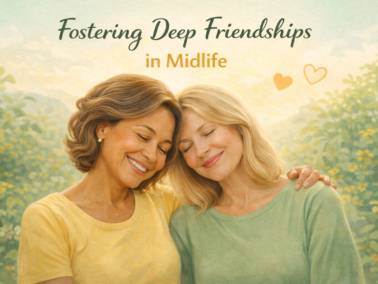
There is a particular kind of loneliness that no one talks about.
Not the loneliness of being alone — you may be surrounded by people, busy with family, active in your community, never technically by yourself. But the loneliness of not being known. Of moving through your days without a single person who sees the whole of you — the complicated, contradictory, still-becoming-herself whole of you — and loves what they see.
It is the loneliness of the woman who has dozens of contacts in her phone and no one to call when something really matters. The loneliness of the woman who realises, with a quiet shock, that she cannot remember the last time she had a conversation that went below the surface. The loneliness of the woman who is, by every external measure, well-connected — and who feels, in the private hours, profoundly alone.
If you recognise that feeling, I want you to know two things.
First: you are not alone in feeling alone. Research consistently shows that loneliness among midlife women is far more common than we acknowledge — a quiet epidemic hiding behind busy schedules and full social media feeds.
Second: this is not a permanent condition. It is not a reflection of your worth, your likability, or your capacity for connection. It is the predictable result of a set of life circumstances that quietly erode social connection in the 50s — and it is entirely, beautifully reversible.
This post is about how.
We're going to cover everything: why friendships change in midlife, what the science says about why deep connection is not a luxury but a biological necessity, the real barriers that get in the way and how to move through them, how to deepen the friendships you already have, how to make new ones (yes, after 50, yes, really), the rituals and rhythms that sustain deep connection over time, and how all of it connects to your four pillars of holistic well-being.
By the end, you will have everything you need to do the one thing that the research says matters more than almost anything else for your health, your happiness, and the quality of the decades ahead:
Reach out. Go deep. Let yourself be known. 💛
Why Friendships Change in Midlife: Understanding the Drift
Most women don't lose their friendships dramatically. There is no falling-out, no betrayal, no definitive ending. There is just... drift.
The slow, almost imperceptible loosening of bonds that once felt unbreakable. The months between catch-ups that stretch to a year. The conversations that stay on the surface because there isn't time — or energy, or the right moment — to go deeper. The gradual replacement of the friends who knew you at your most unguarded with a wider, thinner network of people who know you only in your current role.
And then one day you look up and realise: the social world that once felt rich and sustaining has quietly become something much thinner. And you're not entirely sure how it happened.
Here's how it happened.
The Life Transitions That Quietly Erode Connection
The 50s bring a particular cluster of transitions that each, individually, would be manageable — but together create a perfect storm of social disruption:
The empty nest removes one of the most reliable social structures of midlife: the school-gate network, the parent WhatsApp groups, the friendships built around shared children's activities. When the children leave, the scaffolding that held those friendships in place often leaves with them.
Career transitions and retirement dissolve the workplace social structure that many women rely on more than they realise. Work provides daily proximity, shared purpose, and the kind of repeated unplanned interaction that naturally produces friendship. When it ends — or changes significantly — the social world it sustained often ends with it.
Relocation — your own or your friends' — creates geographic distance that good intentions rarely bridge. We mean to visit. We mean to call. Life intervenes.
Relationship changes — divorce, widowhood, the shifting dynamics of long partnerships — reshape social circles in ways that can be disorienting and isolating. Couple friendships dissolve. Social invitations change. The identity that organised your social world reorganises itself around a new centre.
Bereavement takes not just the people we love but the social networks built around them — the friends of friends, the communities of shared connection, the people who knew us through the person we've lost.
And underneath all of this: the broader cultural reality that researchers have begun calling the friendship recession — a documented, decades-long decline in the number of close friends adults report having. In 1990, only 3% of Americans reported having no close friends. By 2021, that number had risen to 12% — and among women over 50, the figures are even more striking. [1]
The Friendship Maintenance Gap
Here is something nobody tells you: adult friendships require active, intentional maintenance in a way that younger friendships simply don't.
When you were younger, friendship was structurally supported. School, university, early workplaces — these environments provided the daily proximity, the repeated contact, and the shared experience that naturally produce and sustain close bonds. You didn't have to try to maintain your friendships. The structure did it for you.
In midlife, that structure is gone. And most of us were never taught the skills to replace it — because we never needed them before. The result is the friendship maintenance gap: the space between the friendships we want and the effort we know how to make to sustain them.
The good news: these are learnable skills. And the research on what actually works is clear, practical, and genuinely encouraging.
The Distinction That Changes Everything
Before we go further, it's worth being precise about what we're actually talking about — because not all social connection is equal.
Researchers distinguish between three levels of social relationship:
- Acquaintances: people you know and interact with pleasantly but without depth or mutual investment
- Casual friends: people you enjoy spending time with, share some history with, but don't confide in deeply
- Deep friends: people who know the real you — your fears, your history, your contradictions, your becoming — and who you know in the same way
The research is unambiguous: it is the third category — deep friendship — that produces the extraordinary health and well-being benefits we're about to explore. A large network of acquaintances and casual friends, while pleasant, does not protect against loneliness, does not buffer against stress, and does not produce the longevity benefits that deep connection does. [1][2]
Quality, not quantity. Depth, not breadth. Two or three people who truly know you are worth more — to your health, your happiness, and your longevity — than twenty people who know you pleasantly. [1][2]
The Science of Friendship: Why Deep Connection Is a Health Imperative
Let's talk about what the research actually says — because it is more extraordinary than most people realise, and it reframes friendship from a social nicety to an essential health practice.
The Harvard Study of Adult Development
The longest-running study of adult happiness in history began in 1938 and has followed its participants — now into their 90s — for over 85 years. It is the most comprehensive investigation of what actually determines human health and happiness across a lifetime ever conducted.
The finding that its current director, Dr. Robert Waldinger, describes as the study's single most important conclusion:
"The people who were most satisfied in their relationships at age 50 were the healthiest at age 80."
Not the wealthiest. Not the most successful. Not the most physically fit. The most connected. The quality of relationships at midlife is the single strongest predictor of physical health, cognitive function, and happiness in later life — more powerful than any other factor the study measured. [1]
The mechanism is not mysterious: people with close, warm relationships have lower stress hormones, lower inflammation, stronger immune function, and better sleep — all of which compound over decades into dramatically better health outcomes. People with poor social connection show the opposite pattern — elevated cortisol, higher inflammation, compromised immune function — with consequences that accumulate over time into exactly the chronic diseases that most threaten health after 50. [1][2]
The Blue Zones
Dan Buettner's research on the world's longest-lived communities — the Blue Zones of Sardinia, Okinawa, Nicoya, Ikaria, and Loma Linda — identified nine lifestyle factors shared by people who regularly live past 100 in good health.
Social connection appears in every single Blue Zone community — not as a peripheral feature but as a central, structural element of daily life. In Okinawa, the tradition of moai — small groups of lifelong friends who meet regularly, support each other through difficulty, and share both celebration and hardship — is considered one of the primary explanations for the community's extraordinary longevity. [2]
The lesson from the Blue Zones is not subtle: the communities where people live longest are the communities where people are most deeply connected to each other. Longevity is not primarily a solo achievement. It is a social one.
Loneliness as a Health Risk
Dr. Julianne Holt-Lunstad at Brigham Young University has conducted the most comprehensive meta-analysis of loneliness and health ever undertaken — reviewing data from over 3.4 million people across 148 studies.
Her findings are stark: loneliness is as damaging to physical health as smoking 15 cigarettes a day. It is more dangerous than obesity. It increases the risk of premature death by 26%, the risk of heart disease by 29%, and the risk of stroke by 32%. [3]
These are not small effects. They are effects of the magnitude that would prompt immediate public health intervention if they were associated with any other behaviour. And yet loneliness — particularly among midlife and older women — remains largely unaddressed, unacknowledged, and unnamed.
Dr. Holt-Lunstad has called for loneliness to be treated as a public health crisis. The Surgeon General of the United States issued an advisory in 2023 declaring loneliness an epidemic. The UK appointed a Minister for Loneliness in 2018.
The science is not ambiguous: social isolation is not a personal failing or a minor inconvenience. It is a serious health risk — and deep friendship is one of the most powerful protective factors available. [3]
Oxytocin and the Tend-and-Befriend Response
When women experience stress, the primary biological response is not the fight-or-flight response most commonly described in the research — which was, for decades, studied almost exclusively in male subjects. Women's stress response includes a second, equally powerful pathway: tend and befriend.
Under stress, women release oxytocin — the bonding neurochemical — which drives them toward social connection, toward nurturing others and seeking the comfort of trusted relationships. This response activates the parasympathetic nervous system, reduces cortisol, lowers blood pressure, and produces the calm, connected feeling that is the physiological opposite of the stress response. [1][2]
Deep friendship is, for women, literally a biological stress-regulation mechanism. When you reach out to a close friend in a difficult moment — when you sit across from someone who knows you and let yourself be seen — your body is doing exactly what it evolved to do. The relief you feel is not weakness. It is biology working perfectly. [1][2]
Quality Over Quantity: What the Research Actually Shows
One of the most important — and most counterintuitive — findings in friendship research is that more friends does not mean better well-being.
Robin Dunbar, the Oxford anthropologist who has spent decades studying human social networks, has found that the human brain can maintain approximately 150 social relationships — but only 5 of those can be truly close, and only 1.5 can be genuinely intimate. These numbers are remarkably consistent across cultures, across history, and across individuals. [4]
The well-being benefits of social connection are almost entirely concentrated in the innermost circle — the 2 to 5 people with whom you have genuine depth, genuine reciprocity, and genuine mutual knowledge. A large outer network of pleasant acquaintances adds relatively little to well-being. The inner circle of deep friends adds enormously. [1][2][4]
This is liberating news. You don't need a large social life. You need a deep one. Two or three genuine, close, reciprocal friendships — tended with care and consistency — will do more for your health and happiness than any number of surface-level connections. [1][2]
The Barriers to Deep Friendship in Midlife (And How to Move Through Them)
Understanding why friendships matter is one thing. Actually building and sustaining them is another — and there are real barriers that get in the way. Let's name them honestly, and then let's move through them.
Time Scarcity
The most commonly cited barrier — and the one most likely to be both real and overstated.
Yes, midlife is genuinely busy. The competing demands of career, caregiving, ageing parents, and the logistics of a full life are real. Time is genuinely limited.
But here is the reframe the research supports: friendship is not a reward for when everything else is done. It is essential maintenance for the person doing everything else.
The women who consistently say they don't have time for friendship are often the same women who are running on empty — who are giving everything to everyone else and wondering why they feel depleted, resentful, and alone. Friendship is not the luxury at the bottom of the list. It is the fuel that makes the list possible.
The research on time and friendship is also clarifying: deep friendship does not require large amounts of time. It requires consistent time — small, regular, protected contact that signals: you matter to me, I am not going to let us drift. Twenty minutes on the phone. A standing monthly lunch. A voice note on a Tuesday morning. The quantity is less important than the consistency. [1][2]
Vulnerability Resistance
This is the deeper barrier — the one that time scarcity often masks.
Making and deepening friendships requires vulnerability: the willingness to be seen before you know how you'll be received, to reach out before you know if the reach will be returned, to say "I miss you" or "I've been struggling" or "I'd love to be closer friends" without any guarantee of how it will land.
And vulnerability, for many women over 50, has been trained out of them by decades of experience. The professional environments that rewarded composure over authenticity. The relationships that punished openness. The cultural messages that equated emotional need with weakness.
Dr. Brené Brown's research is unambiguous on this point: vulnerability is not weakness. It is the birthplace of connection. There is no deep friendship without it — because depth requires disclosure, and disclosure requires the courage to be seen. [5]
The antidote to vulnerability resistance is not the elimination of fear — it is the recognition that the fear is worth moving through. That the risk of reaching out is almost always smaller than it feels, and the reward almost always larger.
The "I'm Too Old to Make New Friends" Belief
This belief is understandable, deeply common, and neurologically false.
The brain retains its capacity for new social bonds throughout life. The same neuroplasticity that allows new learning, new skills, and new habits also allows new friendships — at 50, at 60, at 70, and beyond. The conditions for friendship formation change in midlife, but the capacity does not. [1][2]
What changes is the structure — the automatic proximity and repetition that younger environments provided. What replaces it is intention — the deliberate creation of the conditions that allow new friendships to form. More on exactly how to do that in the next section.
Geographic Distance
One of the most practically challenging barriers — and one that technology has made significantly more manageable, if we use it well.
The research on long-distance friendship maintenance is clear: what matters is not physical proximity but consistent contact. Regular voice or video calls, voice note exchanges, shared reading or watching, annual visits — these can sustain deep friendship across any distance, if both people are committed to the maintenance. [1][2]
What doesn't work: the annual catch-up that tries to compress twelve months of life into three hours. The friendship that exists entirely in the intention to reconnect. The relationship maintained by social media likes rather than genuine communication.
Distance is a real challenge. It is not an insurmountable one.
Social Anxiety and Introversion
For women who find social situations draining, anxiety-provoking, or simply exhausting, the advice to "put yourself out there" can feel not just unhelpful but actively counterproductive.
Two important distinctions: introversion is not a barrier to deep friendship — introverts often form the deepest, most reciprocal friendships of anyone, precisely because they prefer depth to breadth and quality to quantity. The challenge for introverts is not the depth of friendship but the formation of it — the initial social exposure required to find the people worth going deep with.
For social anxiety specifically: the research consistently shows that avoidance increases anxiety, while gradual, supported exposure reduces it. Small steps — one new social situation, one reached-out-to acquaintance, one accepted invitation — build the evidence base that social connection is safe, that the feared rejection rarely materialises, and that the reward of connection is worth the discomfort of the approach. [1][2]
Deepening Existing Friendships: From Surface to Soul
The most accessible place to begin is not with new friendships but with the ones you already have — the relationships that have the history, the warmth, and the foundation for depth, but that have settled into a comfortable shallowness that no longer fully nourishes either of you.
The Intimacy Gradient
Friendship depth is not binary — it exists on a gradient, and it moves in both directions. Friendships that were once deep can become shallow through neglect. Friendships that have been pleasantly surface-level can become profound through intentional deepening.
The movement from surface to soul happens through progressive self-disclosure — the gradual, reciprocal sharing of increasingly personal, vulnerable, and meaningful information. Not all at once — that is not vulnerability, that is overwhelm. But incrementally, consistently, with the trust that builds as each disclosure is received with care. [5][6]
The 36 Questions
Dr. Arthur Aron at Stony Brook University designed a set of 36 questions specifically to accelerate the development of interpersonal closeness — moving two people from strangers to genuine intimacy in a single conversation. The questions move through three sets of increasing depth and vulnerability, from relatively light ("What would constitute a perfect day for you?") to genuinely profound ("Of all the people in your life, whose death would you find most disturbing, and why?"). [6]
The research on these questions is remarkable: pairs who completed all 36 reported significantly greater feelings of closeness than control pairs who had conventional conversations — and several pairs from the original study became genuine long-term friends.
You don't need to use the questions formally — but the principle they embody is one of the most powerful tools available for deepening existing friendships: ask better questions, and then really listen to the answers.
The Four Levels of Conversation
Most social conversation operates at the first two levels:
- Small talk — weather, logistics, surface pleasantries
- Information exchange — what's happening in your life, news, updates
- Opinions and ideas — what you think, believe, value
- Feelings and experiences — what you feel, fear, hope for, grieve, love
Deep friendship lives at levels three and four. Most midlife social interaction stays at levels one and two — not because the depth isn't wanted, but because no one makes the first move to go deeper.
You can be the one who makes that move. Not dramatically, not all at once — but by asking the question that goes one level deeper than the conversation is currently at. "How are you really doing?" instead of "How are you?" "What's that been like for you?" instead of moving on to the next topic. "I've been thinking about something — can I share it with you?"
These are small moves. Their effect on the depth of a friendship is not small at all.
Showing Up in Difficulty
Research on friendship consistently identifies one factor above all others as the deepest bond-builder available: being genuinely present when someone is struggling.
Not with solutions. Not with silver linings. Not with the discomfort-reducing rush to make things better. With presence — the willingness to sit with someone in their difficulty, to witness their pain without flinching, to say "I'm here, and I'm not going anywhere" — and mean it.
The friendships that survive difficulty — that are tested by grief, by illness, by failure, by the moments when someone is at their least presentable — are the friendships that become unbreakable. Showing up in the hard moments is not just an act of kindness. It is the most powerful friendship-deepening act available. [1][2]
The Friendship Audit
This is a practice worth doing once a year, with honesty and without judgment:
Look at the friendships in your life and ask, for each one:
- Does this friendship nourish me — do I feel better, more myself, more alive after time with this person?
- Is this friendship reciprocal — does the care, the effort, the investment flow in both directions?
- Is this friendship growing — are we going deeper over time, or staying at the same comfortable surface?
- Is this friendship honest — can I be real with this person, or do I perform a version of myself?
The audit is not about culling friendships ruthlessly. It is about seeing clearly — and then investing your limited time and energy in the relationships that genuinely nourish you, rather than spreading yourself thinly across a wide network of connections that leave you feeling emptier than before. [1][2]
Making New Friends After 50: It's Not as Hard as You Think
Here is the truth about making new friends in midlife: it is harder than it was at 22, and easier than you think it is right now.
It is harder because the structural supports are gone — the school, the university, the early workplace that automatically provided proximity, repetition, and shared experience. It requires more intention, more initiative, and more tolerance for the mild awkwardness of adult friendship-formation.
It is easier than you think because most of the fear around it — the fear of rejection, of seeming desperate, of being too old, of it being weird — is significantly larger than the actual risk. The research on this is both humbling and liberating: people dramatically and consistently overestimate how awkward it is to reach out, and dramatically underestimate how warmly the reach will be received. [1][2]
The Proximity-Repetition-Unplanned Interaction Formula
Psychologists have identified three conditions that reliably produce friendship between adults:
- Proximity: being in the same physical space as someone regularly
- Repetition: encountering them repeatedly over time
- Unplanned interaction: having the opportunity for spontaneous, low-stakes conversation
This is why school and work produce friendships so naturally — they provide all three conditions automatically. In midlife, you have to create them deliberately. The most effective way to do this: join something with a regular meeting schedule. A class, a club, a group, a team — anything that puts you in the same room as the same people, repeatedly, over time. [4]
Where to Find Your People
The specific venue matters less than the regularity and the shared interest. But here are the environments that the research and the lived experience of women over 50 consistently identify as the most fertile ground for new friendship:
- Classes and courses: art, language, cooking, photography, pottery, writing — anything that combines learning with regular group contact
- Fitness groups: walking groups, running clubs, yoga studios, swimming groups, hiking clubs — shared physical challenge is a powerful bond-builder
- Book clubs and reading groups: the combination of shared intellectual engagement and regular meeting creates ideal friendship conditions
- Volunteer organisations: shared purpose and values create some of the deepest bonds available — and volunteering consistently ranks among the most effective antidotes to loneliness in the research
- Faith and spiritual communities: for women for whom this resonates, faith communities provide regular contact, shared values, and a culture of mutual care
- Professional networks and alumni associations: shared history and professional identity create natural common ground
- Online communities: while not a replacement for in-person connection, online communities — particularly those organised around specific interests or identities — can be a genuine source of meaningful connection, and can bridge the gap to in-person friendship
The Friendship Funnel
Meeting someone is not the same as making a friend. The movement from acquaintance to friend requires a series of small, deliberate steps — each one slightly more personal than the last:
- Regular pleasant contact in the shared environment — the class, the group, the club
- A specific, low-stakes invitation to extend the connection beyond the shared environment: "Would you like to grab a coffee after class sometime?"
- A one-on-one meeting — the coffee, the walk, the lunch — where the conversation can go deeper than the group setting allows
- Progressive self-disclosure — sharing something slightly more personal, and receiving the same in return
- A second invitation — because one coffee does not a friendship make; it is the repetition that builds the bond
- Consistency — the regular contact that signals mutual investment and prevents the drift back to acquaintance
The step that most people skip — and that makes the difference between a pleasant acquaintance and a genuine new friend — is step two: the specific invitation. Most people wait for friendship to happen to them. The research says that the people who make new friends most successfully are the ones who make the first move — consistently, without waiting for a perfect moment, and with the confidence that comes from knowing the research: most people will say yes, and almost no one will find it weird. [1][2]
Friendship Rituals: The Structures That Sustain Deep Connection
Deep friendship is not maintained by grand gestures. It is maintained by small, consistent acts of attention — the rituals and rhythms that signal, again and again: you matter to me, I am not going to let us drift.
The Standing Date
The single most effective friendship maintenance strategy available — and the simplest.
A standing date is a recurring, protected time with a specific friend that doesn't require rescheduling because it is already in both calendars. The first Monday of every month. Every other Thursday evening. The last Sunday of the quarter. Whatever works — the specificity is what makes it work.
The standing date removes the single greatest obstacle to friendship maintenance: the friction of scheduling. When you have to actively arrange every meeting, the meetings happen less and less frequently — because life is busy, and the path of least resistance is always to postpone. When the meeting is already in the calendar, it happens. [1][2]
Micro-Connections
Research on friendship maintenance consistently finds that frequency of contact matters more than duration. A two-minute voice note on a Tuesday morning — "I heard this song and thought of you" — does more for the health of a friendship than a three-hour catch-up every six months.
Micro-connections are the small, frequent signals of attention that keep a friendship alive between the bigger meetings:
- A voice note sharing something that made you think of them
- A photo of something they would appreciate
- An article, a podcast, a book recommendation with a personal note
- A "thinking of you" text on a day you know is hard for them
- A voice message instead of a text — because hearing someone's voice carries warmth that words on a screen cannot
These are not grand gestures. They are the texture of a living friendship — the evidence, accumulated over time, that you are held in someone's mind and heart even when you're not in the same room. [1][2]
Shared Experiences Over Shared Time
Research on what deepens friendship most quickly points consistently to one factor: novel, slightly challenging shared experiences produce greater intimacy than familiar, comfortable ones.
Trying something new together — a class neither of you has taken, a trip to somewhere neither of you has been, a challenge that requires mutual support and problem-solving — creates the kind of shared memory and mutual vulnerability that accelerates friendship depth in ways that pleasant familiar routines simply don't. [1][2]
This doesn't require anything dramatic. A new restaurant in an unfamiliar neighbourhood. A hike on a trail you've never walked. A pottery class where you're both beginners. The novelty and the mild challenge are what matter — not the scale.
Long-Distance Friendship Rituals
For the friendships that matter most but are separated by geography, the research points to a few specific practices that actually work:
- Regular scheduled calls — not "we should catch up soon" but "every other Sunday at 4pm"
- Voice note exchanges — asynchronous audio conversation that fits around different schedules and time zones
- Shared reading or watching — a book club of two, a series you're watching simultaneously and discussing
- Annual visits — a protected, planned trip that both people commit to in advance and treat as non-negotiable
- Handwritten letters — slower, more deliberate, and more deeply felt than any digital communication
The common thread: intention and structure. Long-distance friendships don't maintain themselves. They require the deliberate creation of the conditions for connection — and the mutual commitment to show up for those conditions consistently. [1][2]
Being a Good Friend: The Qualities That Attract and Sustain Deep Connection
We have talked about what to do. Let's talk about who to be.
Because the most important factor in the quality of your friendships is not the strategies you employ or the venues you frequent. It is the kind of friend you are — the qualities you bring to your relationships that make people feel safe, seen, valued, and genuinely glad to know you.
The research on what makes someone a deeply valued friend consistently identifies the same qualities:
Reliability: You show up when you say you will. You follow through on what you commit to. You are the person your friends can count on — not because you are perfect, but because your word means something. In a world of casual commitments and easy cancellations, reliability is a profound act of love.
Presence: When you are with your friend, you are with your friend. Not half-present, not distracted by your phone, not composing your response while they're still speaking. Genuinely, fully there — listening not to respond but to understand. The gift of full attention is rarer and more precious than most people realise.
Generosity: You give without keeping score. You celebrate your friends' successes without the shadow of comparison. You offer your time, your attention, your care — not as a transaction but as an expression of genuine love.
Honesty: You tell the truth — with kindness, with care, with the full awareness of how much it costs to hear — but you tell it. The friend who only ever tells you what you want to hear is not a deep friend. The friend who loves you enough to be honest is one of the most precious people in your life.
Celebration: Research on what psychologists call capitalisation — the sharing of good news — consistently finds that how a friend responds to your good news matters as much as how they respond to your bad news. The friend who genuinely delights in your successes, who celebrates your wins without reservation, who is glad for you — that friend is a treasure. Be that friend.
Repair: Every friendship of sufficient depth will, at some point, experience friction — a misunderstanding, a hurt, a moment of failure. The friendships that survive these moments and emerge stronger are the ones where both people have the courage and the humility to repair. To say "I'm sorry" and mean it. To say "that hurt me" and trust that it will be received. The capacity for repair is not a sign of a troubled friendship. It is a sign of a real one.
Friendship and Your Four Pillars of Well-Being
One of the most remarkable things about deep friendship is how completely it nourishes every dimension of your holistic well-being — not just the emotional. Let's look at how it connects to each of your four pillars.
💪 Physical Well-Being
The physical benefits of deep friendship are among the most extensively documented in all of health research:
- Longevity: The Harvard Study, the Blue Zones research, and dozens of independent studies all point to the same conclusion — people with close, warm relationships live significantly longer than those without [1][2]
- Cardiovascular health: Deep social connection reduces blood pressure, lowers resting heart rate, and reduces the chronic inflammation that underlies most cardiovascular disease [1][2][3]
- Immune function: Lonely people show measurably compromised immune function; deeply connected people show the opposite — stronger immune response, faster recovery from illness, lower rates of chronic disease [3]
- Cortisol regulation: The tend-and-befriend response triggered by female social bonding reduces cortisol more effectively than almost any other available intervention [1][2]
For the complete physical well-being picture, see our posts on [Nutrition for Bone Health and Osteoporosis Prevention], [Strength Training to Combat Age-Related Muscle Loss], and [Essential Health Screenings for Women Over 50].
📚 Intellectual Well-Being
Deep friendship is one of the most cognitively stimulating activities available — and one of the most underrated:
- Cognitive engagement: Navigating complex human relationships — understanding another person's perspective, tracking the history and nuance of a long friendship, engaging in substantive conversation — is among the most demanding cognitive work the brain does [1][2]
- Dementia protection: Social engagement is one of the most consistently identified protective factors against cognitive decline and dementia — the social brain hypothesis suggests that the brain evolved specifically for complex social navigation, and that maintaining that navigation keeps it sharp [4]
- Intellectual stimulation: Deep friends challenge your thinking, expose you to new perspectives, and provide the kind of intellectual friction that keeps the mind growing
For more on intellectual well-being, see our posts on [Lifelong Learning: Keeping Your Brain Sharp After 50] and [Puzzles, Games, and Brain Training for Mental Agility].
🌿 Spiritual Well-Being
At its deepest, friendship is a spiritual experience — the experience of being truly known and truly loved, which is among the most transcendent available to human beings.
To be seen — fully, honestly, without performance or pretence — and to be loved in that seeing: this is not a small thing. It is one of the most profound experiences of meaning, of mattering, of connection to something larger than yourself, that life offers.
The research on meaning and purpose consistently identifies deep relationships as one of the primary sources of the sense that life is worth living — that you matter, that your presence makes a difference, that you are part of something that extends beyond your individual self. [1][2]
For more on spiritual well-being, see our posts on [Finding Purpose and Meaning in Your 50s] and [Daily Meditation Practices for Inner Peace].
💛 Emotional Well-Being
Friendship is the primary emotional well-being resource available to human beings — the buffer against anxiety, the antidote to depression, the container for grief, the amplifier of joy:
- Resilience: People with close friendships recover more quickly from adversity, reframe difficulty more effectively, and maintain greater emotional stability in the face of challenge [1][2]
- Depression and anxiety: Social connection is one of the most consistently effective protective factors against both depression and anxiety — and social isolation is one of the most consistent risk factors [3]
- Emotional regulation: The co-regulation that happens in close friendship — the way another person's calm presence can settle your nervous system, the way being witnessed in your emotion allows it to move through rather than get stuck — is one of the most powerful emotional regulation tools available [1][2]
- Joy amplification: Positive experiences are more joyful when shared. The research on capitalisation consistently finds that sharing good news with someone who genuinely celebrates it doubles the emotional benefit of the experience itself [1][2]
For more on emotional well-being, see our posts on [Building Emotional Resilience During Life Transitions], [Navigating Menopause Emotions with Mindfulness], and [Gratitude Practices to Cultivate Contentment].
The Bravest Thing You Can Do
Vera sent the text.
She'd been composing it in her head for three weeks. Editing it, second-guessing it, putting her phone down and picking it up again. Is it weird? Will she think I'm desperate? It's been so long — will it be awkward?
And then one Tuesday morning, before she could talk herself out of it again, she typed it and pressed send.
"I've been thinking about you. I miss you. Can we find a time?"
The reply came within the hour.
"I was literally just thinking about you. YES. When?"
That is the story the research tells, over and over again. The reach that feels enormous from the inside is almost always received with warmth. The vulnerability that feels like a risk is almost always met with relief — because the other person has been wanting to reach out too, and didn't know how, and was waiting for someone to go first.
You can be the one who goes first.
Not because it isn't scary. It is. But because the research is unambiguous about what is on the other side of that small act of courage: better health, longer life, greater happiness, and the irreplaceable experience of being truly known by another human being.
You are worth knowing deeply. And so are the women around you.
One Action, Today
The research on behaviour change is clear: the most effective action is the smallest one you will actually take.
So here is your invitation — not to overhaul your social life, not to join five new groups, not to have a series of profound conversations. Just one thing:
Think of one person you've been meaning to reach out to. And send the message today.
Not a perfectly crafted message. Not a long explanation of why it's been so long. Just: "I've been thinking about you. How are you?"
That's it. That's the whole action. That's the beginning of everything.
Your Free Friendship Deepening Guide
📥 Download your free Friendship Deepening Guide — your complete toolkit including the 36 Questions for deepening any friendship, a friendship audit template, a friendship calendar system, 50 conversation starters for going deeper, a long-distance friendship maintenance plan, and a 30-day friendship challenge designed specifically for women over 50 who are ready to invest in the relationships that matter most.
💌 Subscribe for weekly Emotional Well-Being insights for women over 50 — because your relationships deserve the same intentional nourishment as your body and your mind.
💬 Tell me in the comments: Who is one person in your life you've been meaning to reach out to — but haven't yet? Tell me below. And then go send the text. I mean it. Right now. The post will still be here when you get back. 💛
📲 Share this post with a woman in your life who needs to hear this:
"You are worth knowing deeply. And so are the women around you." 💛
As a certified wellness coach, I share evidence-based insights drawn from peer-reviewed research in psychology, neuroscience, and social science. This post is for informational and educational purposes only and does not constitute medical or psychological advice. If you are experiencing significant depression, anxiety, or the effects of chronic loneliness, please consult a qualified mental health professional.
References
[1] Harvard Study of Adult Development — Dr. Robert Waldinger
[2] Blue Zones Research — Dan Buettner
[3] Dr. Julianne Holt-Lunstad — Loneliness and Health Research, Brigham Young University
[4] Robin Dunbar — Social Brain Hypothesis, University of Oxford
[5] Dr. Brené Brown — Vulnerability and Connection Research
[6] Dr. Arthur Aron — 36 Questions / Interpersonal Closeness Research, Stony Brook University