There is a particular kind of exhaustion that has nothing to do with being tired.
You know the one. It's the feeling of having everything you're supposed to want — a home, relationships, a life that looks, from the outside, perfectly fine — and still feeling like something is missing. Still scanning the horizon for the thing that will finally make you feel settled. Satisfied. Enough.
Maybe it shows up as a low-level restlessness. A sense that happiness is always just slightly out of reach — just past the next milestone, the next achievement, the next improvement. When I lose the weight. When the kids are sorted. When I retire. When things calm down. Then I'll be happy.
Maybe it shows up as comparison — scrolling through images of other women's lives and feeling the quiet, corrosive sense that yours doesn't quite measure up.
Maybe it shows up as a kind of numbness — a going-through-the-motions quality to days that are, objectively, full of good things you've somehow stopped noticing.
If any of that sounds familiar, I want to offer you something. Not a solution, exactly. Not a fix. Something quieter and more radical than that.
I want to offer you the possibility that everything you need to feel content is already present in your life — and that what's missing is not more, but attention.
That is the promise of gratitude — not as a platitude, not as a bumper sticker, not as the kind of forced positivity that dismisses real pain — but as a genuine, neuroscience-backed, life-changing practice that has been shown, repeatedly and rigorously, to be one of the most powerful tools available for human well-being.
In this post, we're going to cover everything: the crucial difference between contentment and happiness, the neuroscience of what gratitude actually does to your brain, why it's especially powerful after 50, eight powerful practices backed by research, how to build a daily gratitude ritual that actually sticks, the pitfalls to avoid, and how it all connects to your four pillars of holistic well-being.
By the end, you will have everything you need to begin — or deepen — a gratitude practice that genuinely changes how you experience your life.
Not by changing your circumstances. By changing your attention. 💛
Contentment vs. Happiness: Why the Distinction Changes Everything
Before we talk about gratitude, we need to talk about what we're actually trying to cultivate — because most of us have been chasing the wrong thing.
We've been chasing happiness.
And happiness, it turns out, is a terrible goal.
Not because it isn't wonderful when it arrives — it is. But because happiness, in the way most of us pursue it, is fleeting, fragile, and fundamentally dependent on external circumstances. It is the peak emotion — the birthday, the promotion, the perfect holiday, the moment everything comes together. It arrives, it lifts you, and then it passes. And then you're back to baseline, scanning the horizon for the next thing that will bring it back.
This is not a personal failing. It is biology.
Psychologists call it hedonic adaptation — the brain's remarkable, maddening tendency to return to a relatively stable baseline level of well-being regardless of what happens to you. Win the lottery? Within a year, your happiness levels return to roughly where they were before. Get the promotion? The new car? The bigger house? The initial surge of happiness fades, the new normal becomes the new baseline, and the horizon shifts again. [1]
The brain habituates to good things with the same efficiency it habituates to bad ones. It is designed for survival, not for sustained joy.
Contentment is different.
Contentment is not a peak emotion. It is a ground state — a quiet, stable, sustainable sense of sufficiency and peace. It is not the fireworks of happiness; it is the warmth of a fire you've tended carefully over time. It doesn't depend on everything going right. It doesn't require the next milestone or the next achievement. It is available right now, in this ordinary moment, in this ordinary life — if you know how to access it.
And the most reliable key to contentment — the one that the research returns to again and again — is gratitude.
Dr. Sonja Lyubomirsky, one of the world's leading happiness researchers, has spent decades studying what actually determines human well-being. Her findings, summarised in what has become known as the happiness pie chart, are both humbling and profoundly empowering: approximately 50% of our happiness baseline is determined by genetics — our temperamental set point, largely fixed. About 10% is determined by our life circumstances — income, relationship status, where we live. And a full 40% is determined by intentional activity — the things we deliberately choose to think, do, and practice. [1][2]
Forty percent. Under your direct influence. Available to you right now.
Gratitude is one of the most powerful intentional activities available — and one of the most extensively researched. It is not the whole 40%. But it may be the most accessible, most immediate, and most transformative entry point into it.
The Neuroscience of Gratitude: What's Actually Happening in Your Brain
Let's talk about what gratitude actually does — not philosophically, but biologically. Because understanding the mechanism makes the practice feel less like a nice idea and more like the essential self-care it truly is.
The Brain's Reward System — Dopamine and Serotonin
When you experience genuine gratitude — when you really feel it, not just think it — your brain releases dopamine and serotonin, the two primary neurotransmitters associated with pleasure, motivation, and well-being. [1][2][3]
Dopamine is the brain's reward signal — the neurochemical that says "that was good, do it again." When you practice gratitude consistently, you are essentially training your brain to seek out and notice positive experiences — because the brain, like any learning system, moves toward what it has been rewarded for noticing. [1][2]
Serotonin is the brain's stability signal — associated with mood regulation, emotional resilience, and the quiet sense of well-being that underlies contentment. Low serotonin is associated with depression, anxiety, and emotional volatility. Gratitude practice is one of the most reliable non-pharmacological ways to increase serotonin production. [1][2][3]
The Prefrontal Cortex — Rewiring for Positivity
Dr. Glenn Fox at the USC Brain and Creativity Institute has used neuroimaging to identify exactly which brain regions activate during genuine gratitude experiences. The primary region: the medial prefrontal cortex — the brain's centre for empathy, moral reasoning, and interpersonal connection. [3]
This is significant for two reasons. First, it means that gratitude is not a passive emotional experience — it is an active cognitive and social one, engaging the brain's most sophisticated regions. Second, it means that consistent gratitude practice strengthens precisely the neural circuits associated with empathy, connection, and the capacity for positive emotion regulation — making you not just happier, but more emotionally intelligent and socially connected over time. [1][2][3]
Neuroplasticity — Literally Rewiring Your Brain
Here is the finding that changes everything: consistent gratitude practice physically changes the structure of your brain.
Through the same neuroplasticity mechanisms we explored in our post on [Learning New Skills: Hobbies That Challenge the Mind After 50] — the principle that neurons that fire together, wire together — regular gratitude practice strengthens the neural pathways associated with positive emotion, optimism, and well-being. The more consistently you practice noticing what is good, the more efficiently your brain builds the neural architecture for noticing what is good. [1][2]
The brain you have after six months of consistent gratitude practice is measurably different from the brain you have today — more attuned to positive experience, more resilient in the face of difficulty, more naturally inclined toward contentment. This is not metaphor. This is observable, measurable, physical change. [1][2][3]
The Negativity Bias — And Gratitude as the Antidote
Your brain is not neutral. It is, by evolutionary design, negatively biased — wired to weight negative experiences more heavily than positive ones, to scan for threats more vigilantly than opportunities, to remember bad experiences more vividly than good ones.
This bias was essential for survival on the savannah. It is considerably less useful for well-being in the twenty-first century — where it manifests as rumination, anxiety, catastrophising, and the persistent sense that something is wrong even when everything is fine. [1][2]
Gratitude is the most direct, most evidence-based antidote to the negativity bias available. It does not eliminate the bias — it is too deeply wired for that. But it systematically counteracts it, training the brain to give equal — and eventually greater — attention to what is good, safe, and sufficient. [1][2][3]
The Research That Convinced the Scientific Community
The science of gratitude is not new-age speculation. It is one of the most rigorously studied areas in positive psychology — and the findings are consistent and compelling:
- Dr. Robert Emmons (UC Davis) — the world's leading gratitude researcher — found that people who kept weekly gratitude journals reported 25% higher well-being, exercised more, had fewer physical complaints, and felt more optimistic about the coming week than control groups. [1]
- Dr. Martin Seligman (University of Pennsylvania) found that his Three Good Things exercise — writing down three good things that happened each day and why — reduced depression and increased happiness for up to six months from a single week of practice. One of the most replicated findings in all of positive psychology. [2]
- The UCLA Mindfulness Awareness Research Centre found that gratitude activates the hypothalamus — the brain region that regulates stress hormones, sleep, metabolism, and immune function — producing measurable improvements in physical health alongside emotional well-being. [3]
- A 2009 study in the Journal of Research in Personality found that grateful people sleep better, feel more energetic, experience less envy and resentment, and are more compassionate and helpful to others. [1][2]
The evidence is not ambiguous. Gratitude works — not as a mood, not as a personality trait, but as a practice. Something you do deliberately, consistently, and with genuine attention.
Why Gratitude Is Especially Powerful After 50
The research on gratitude applies at every age — but there are specific reasons why it is particularly powerful, particularly well-timed, and particularly transformative for women in their 50s and beyond.
The Post-50 Emotional Landscape
The 50s bring a particular emotional complexity that younger decades rarely do. The landscape shifts in ways that are simultaneously liberating and disorienting: careers transition or end, children leave home, relationships evolve, parents age and die, the body changes in ways that require new attention, and the identity structures that organised earlier decades begin to loosen.
These transitions carry real grief — and that grief deserves to be honoured, not bypassed. Gratitude is not about pretending the losses aren't real. It is about ensuring that the losses don't become the whole story — that the richness, the beauty, and the sufficiency that coexist with the difficulty are also seen, also felt, also counted. [1][2]
The Gift of Perspective
Here is something the "ageing is decline" narrative never acknowledges: the post-50 brain has a genuine emotional advantage that younger brains don't.
Psychologist Laura Carstensen's Socioemotional Selectivity Theory — one of the most important findings in the psychology of ageing — demonstrates that as people age and become more aware of the finite nature of time, they naturally shift their attention toward what is most meaningful and emotionally rich. Older adults are better at savouring positive experiences, more skilled at regulating negative emotions, and more naturally attuned to the present moment than younger adults. [1][2]
In other words: the psychological conditions for gratitude improve with age. The perspective that comes from having lived through difficulty, from having lost things and people you loved, from having learned — sometimes painfully — what actually matters, makes gratitude not just more accessible but more genuine. More earned. More real. [1][2]
Post-Traumatic Growth and the Gratitude Advantage
Research on post-traumatic growth — the well-documented phenomenon of positive psychological change emerging from the struggle with highly challenging life circumstances — consistently identifies gratitude as one of its central features. Women who have navigated significant difficulty — illness, loss, divorce, caregiving, professional setback — and emerged with their resilience intact almost universally describe a deepened capacity for gratitude as part of what changed. [1][2][3]
The losses of your 50s — as real and as painful as they are — may be precisely what makes your gratitude practice more powerful than it could have been at 30. Not because the losses were good, but because they clarified what is.
8 Powerful Gratitude Practices to Cultivate Contentment
Here are eight practices — ranging from the deeply researched to the beautifully simple — that the science consistently identifies as the most effective available. You don't need all eight. You need the one — or the two, or the three — that genuinely call to you. Because the best gratitude practice is the one you love enough to do consistently.
🌿 Practice 1 — The Gratitude Journal
The most researched gratitude practice in existence — and for good reason. It works.
The gratitude journal is simple in concept and profound in effect: each day, you write down specific things you are grateful for, with enough detail and reflection to genuinely feel the gratitude rather than just list it.
The specificity principle is the most important insight in gratitude journaling research: depth beats breadth, every time. Writing one deeply felt, specifically described gratitude — "I am grateful for the way my friend laughed at my terrible joke this morning, and the warmth I felt knowing she genuinely enjoys my company" — produces significantly greater well-being benefit than listing ten generic ones. The brain responds to specificity. Vague gratitude produces vague benefit. Specific, felt gratitude produces real neurochemical change. [1][2]
Morning vs. evening: Research suggests that evening journaling produces slightly greater sleep benefits (you go to bed with a positive emotional state), while morning journaling sets a positive attentional tone for the day ahead. Try both and notice which feels more natural — consistency matters more than timing. [1][2]
Prompts to go deeper:
- What happened today that I almost missed noticing?
- Who made my life easier, warmer, or more beautiful today — and how?
- What does my body allow me to do that I take for granted?
- What ordinary thing, if it disappeared tomorrow, would I desperately miss?
- What difficulty am I grateful for — because of what it taught me or who it made me?
The minimum effective dose: Three to five specific entries, three to four times per week. Daily is ideal — but research shows that journaling every day can lead to habituation. Three to four times weekly maintains the freshness that keeps the practice genuinely felt rather than mechanically performed. [1][2]
✨ Practice 2 — The Three Good Things Exercise
Dr. Martin Seligman's most replicated positive psychology intervention — and one of the simplest, most accessible practices available.
How it works: Each evening, write down three good things that happened today — large or small — and for each one, answer the question: "Why did this good thing happen?"
That second step — the why — is what makes this practice so powerful. It moves you from passive noticing to active attribution, training the brain to connect positive experiences to causes — your own actions, other people's kindness, the world's generosity — rather than treating them as random or undeserved. [2][3]
The research is extraordinary: in Seligman's original study, participants who practiced Three Good Things for just one week showed significant reductions in depression and increases in happiness that persisted for up to six months after the practice ended. Six months of benefit from one week of practice. The neural pathways built by consistent positive attention don't disappear when the practice stops — they persist, continuing to shape how the brain processes experience. [2]
Adaptation for women over 50: The most powerful version of this practice for Vibrant Vera is the deliberate inclusion of small, ordinary moments — the ones that are easiest to overlook and most reliably present. The morning light through the kitchen window. The familiar comfort of a favourite mug. The text from a friend. The body that carried you through another day. These are not consolation prizes for the absence of bigger things. They are the texture of a life — and they are available every single day, regardless of circumstances.
💌 Practice 3 — The Gratitude Letter and Visit
The most powerful single gratitude intervention in the entire positive psychology research literature — and the one most likely to produce a genuinely transformative experience.
How it works: Think of someone who has had a significant positive impact on your life — a teacher, a mentor, a parent, a friend, a colleague — who you have never properly thanked. Write them a detailed, specific letter of gratitude: what they did, how it affected you, who you became because of them. Then — if possible — visit them in person and read the letter aloud.
The research on this practice is remarkable. In Seligman's original study, the Gratitude Visit produced the largest single-session increase in happiness ever recorded in positive psychology research — and the effects persisted for a month after a single visit. [2][3]
The mechanism is profound: the practice simultaneously activates your own gratitude response, strengthens a meaningful relationship, provides the person you're thanking with a deeply meaningful experience, and creates a moment of genuine human connection that both parties carry forward.
If the visit isn't possible: The letter alone — written with full specificity and genuine feeling, even if never sent — produces significant well-being benefits. The act of writing it, of really thinking through what someone meant to you and why, is itself a powerful gratitude practice. [2]
For women over 50: This practice has particular resonance in a life stage where relationships are increasingly recognised as the most precious resource available — and where the awareness of time's finite nature makes unexpressed appreciation feel increasingly urgent. Don't wait. Write the letter. Make the visit. The research says it will be one of the most meaningful things you do this year.
☕ Practice 4 — Savouring: The Art of Conscious Appreciation
Savouring is gratitude in real time — the deliberate, conscious act of fully attending to and appreciating a positive experience as it is happening, rather than letting it pass unnoticed in the rush of the day.
Dr. Fred Bryant at Loyola University Chicago, the world's leading researcher on savouring, identifies three temporal forms of the practice: [3]
- Anticipatory savouring: Deliberately looking forward to something with full, conscious pleasure — not rushing past the anticipation to get to the event, but enjoying the looking-forward as its own experience
- Present-moment savouring: Fully inhabiting a positive experience as it happens — slowing down, engaging all the senses, consciously noting "this is good, I am here, I am noticing this"
- Retrospective savouring: Deliberately revisiting and reliving positive experiences — through memory, photographs, conversation, or journaling — to extend their emotional benefit beyond the moment itself
Practical savouring techniques:
The slow cup of tea or coffee: Before you check your phone, before the day begins, sit with your morning drink and give it your full attention. The warmth of the mug. The smell. The first sip. The quiet. This is not a small thing. This is a daily practice of presence that, done consistently, trains the brain to find richness in the ordinary.
The mindful walk: Walk without a destination or a podcast. Look at things. Really look — the light on leaves, the texture of bark, the way the sky changes. The world is extraordinarily beautiful if you give it your attention. Most of us walk through it looking at our phones.
The deliberate pause: In the middle of a good moment — a meal with people you love, a conversation that makes you laugh, a sunset that stops you — consciously pause and say to yourself: "I want to remember this. I am here. This is good." That deliberate act of noticing doubles the emotional benefit of the experience and significantly improves the likelihood of retaining it in long-term memory. [3]
🔄 Practice 5 — The Gratitude Reframe
This practice is more cognitively demanding than the others — and more powerful for it.
The gratitude reframe is the practice of deliberately looking for the gift, the lesson, or the unexpected benefit in experiences that are neutral, difficult, or painful — not to deny the difficulty, but to ensure it doesn't become the only story.
The "What if it hadn't happened?" technique: This is one of the most effective gratitude amplifiers in the research. Rather than simply noting that something good exists in your life, you deliberately imagine its absence — "What would my life look like if I had never met her? If I had never taken that job? If I had never moved to that city?" — and then return to the present with a renewed appreciation for what is actually there. [1][2]
The psychological mechanism is powerful: we habituate to good things precisely because they are reliably present. Imagining their absence temporarily disrupts that habituation, restoring the freshness of appreciation that familiarity erodes.
Reframing difficulty: This is the most nuanced application of gratitude — and the one most vulnerable to misuse. The question is not "Am I grateful for this painful thing?" — that would be toxic positivity, a dismissal of real experience. The question is: "Is there anything in this difficult experience — any growth, any clarity, any unexpected gift — that I can honestly acknowledge alongside the pain?"
The distinction matters enormously. Genuine gratitude reframing honours the difficulty while refusing to let it be the whole story. Toxic positivity bypasses the difficulty entirely — and in doing so, bypasses the genuine emotional processing that real healing requires. [1][2]
🧘 Practice 6 — Gratitude Meditation and Body Scan
Combining mindfulness with gratitude produces greater well-being benefits than either practice alone — and the combination is particularly powerful for women over 50 navigating a changing relationship with their bodies.
A simple 10-minute gratitude meditation:
Find a comfortable seated position. Close your eyes. Take three slow, deep breaths — in through the nose, out through the mouth — and let the day's noise settle.
Bring to mind one person you are genuinely grateful for. See their face. Remember a specific moment with them. Feel the warmth of that memory in your chest. Stay with it for a full minute — not rushing to the next thought, but really inhabiting the feeling.
Now bring to mind one experience from the past week that you are grateful for — something small is fine, something ordinary is perfect. Revisit it in detail. Where were you? What did it feel like? What made it good?
Finally, bring your attention to your body. Begin at the top of your head and move slowly downward — not looking for what's wrong, but noticing what is working. The eyes that let you read. The ears that let you hear music and laughter. The hands that hold and create and comfort. The legs that carry you. The heart that has beaten, without your asking it to, every moment of your life.
This is the body gratitude scan — and it is one of the most transformative practices available for women over 50, who have often spent decades in a critical, adversarial relationship with their bodies. Shifting from "what is wrong with my body" to "what does my body do for me" is not a small reframe. It is a fundamental shift in the relationship — one that research consistently associates with improved body image, reduced anxiety, and greater physical self-care. [1][2][3]
🫙 Practice 7 — The Gratitude Jar
The most tactile, visual, and cumulative of the gratitude practices — and one of the most quietly powerful.
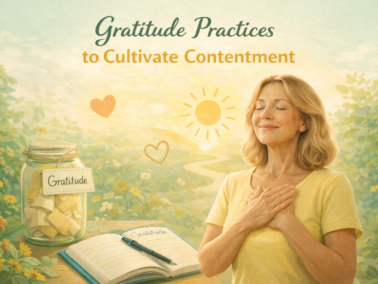
How it works: Place a jar — any jar, beautiful or plain — in a visible location in your home. Each day, write one thing you are grateful for on a small piece of paper and place it in the jar. At the end of the year — or whenever you need a reminder of abundance — sit down and read through everything you've collected.
The power of this practice is threefold: the physical act of writing and placing the note creates a more embodied, memorable experience than digital journaling; the visual presence of the jar in your daily environment serves as a constant, gentle reminder of the practice; and the cumulative effect of a year's worth of gratitude notes — the sheer volume of good things that have happened, that you might otherwise have forgotten — is one of the most viscerally powerful demonstrations of abundance available. [1][2]
Variations: A family gratitude jar — where everyone in the household contributes — creates a shared culture of appreciation and provides a beautiful ritual for reading together at year's end. A digital gratitude jar, using a notes app or a dedicated gratitude app, works equally well for those who prefer it.
💛 Practice 8 — Gratitude in Relationship: Expressing Appreciation to Others
The most social of the gratitude practices — and the one with the most powerful relational benefits.
Research consistently shows that expressed gratitude — gratitude communicated directly to another person — produces greater well-being benefits than unexpressed gratitude, for both the giver and the receiver. It strengthens relationships, increases relationship satisfaction, creates positive feedback loops of mutual appreciation, and builds the social connection that is as essential to emotional health as it is to cognitive health. [1][2][3]
And yet most of us dramatically under-express our appreciation. We feel grateful for the people in our lives — and we assume they know. They often don't. Or they know in the abstract, but they haven't heard it said, specifically and recently, in a way that lands.
Practical forms:
The daily appreciation: Make it a practice to express one specific appreciation to someone in your life each day. Not a generic "thank you" — a specific, felt acknowledgement: "I noticed how you listened to me yesterday when I was struggling, and it meant more than you know."
The unexpected thank-you note: A handwritten note, sent without occasion, expressing specific gratitude for someone's presence in your life. In a world of texts and emails, a handwritten note is an act of love — and its effect on the recipient is disproportionate to the effort it requires.
The verbal acknowledgement: Simply saying, out loud, to the people you love: "I am so grateful you are in my life." Specifically. Regularly. Without waiting for a special occasion.
The social amplification effect is real: gratitude expressed creates gratitude received. When you make appreciation a consistent practice in your relationships, you create an environment in which appreciation flows more freely in both directions — and the relational warmth that results is one of the most reliable sources of the contentment we are cultivating. [1][2]
Building Your Daily Gratitude Ritual
The research is unambiguous on one point above all others: consistency matters more than intensity. A modest gratitude practice done daily produces far greater long-term well-being benefits than an elaborate practice done occasionally. [1][2]
Here is a complete, sustainable daily gratitude ritual — morning and evening — that takes less than fifteen minutes total and produces measurable results within three to four weeks of consistent practice.
Morning Ritual (5–7 minutes)
Upon waking — before your phone:
- Three conscious breaths — arriving in the day before the day arrives in you
- One thing you're looking forward to today — anticipatory savouring, activating positive expectation
- One thing about your body you're grateful for — setting a tone of appreciation rather than criticism for the day ahead
- One person you're grateful for — bringing a face and a feeling of warmth into the first moments of your day
That's it. Four things. Five minutes. Before the news, before the notifications, before the demands of the day begin.
Evening Ritual (7–10 minutes)
Before sleep:
- Three Good Things — what happened today that was good, and why? (Seligman's most powerful intervention)
- One moment I want to savour — retrospective savouring of the day's best moment, in enough detail to really feel it again
- One person I appreciated today — did I express it? If not, how might I tomorrow?
- One sentence of self-compassion — what did I do well today, however small?
Habit Stacking — Making It Stick
The most reliable way to build a new habit is to attach it to an existing one. Possible anchors for your gratitude practice:
- Morning coffee or tea — your gratitude ritual happens while the kettle boils and while you drink your first cup
- Morning shower — a mental gratitude practice while you shower (no journal required)
- Evening skincare routine — your evening gratitude ritual happens while you go through your skincare steps
- Bedtime reading — five minutes of gratitude journaling before you open your book
When Gratitude Feels Forced
This is the most common obstacle — and the most important one to address honestly.
There will be days when gratitude feels hollow. When the journal prompt produces nothing but a blank stare. When the instruction to "find something to be grateful for" feels not just unhelpful but actively irritating.
This is normal. This is human. And it does not mean the practice isn't working.
On those days, the research suggests two approaches: go smaller (not "what am I grateful for in my life" but "what is one thing in this room, right now, that I appreciate") and go physical (hold something warm, step outside, feel sunlight on your face — the body often accesses gratitude more readily than the thinking mind). [1][2]
And on the days when genuine gratitude is genuinely inaccessible — when you are in real pain, real grief, real difficulty — don't force it. Gratitude is not a bypass. It is not a performance. It is not something you owe anyone, including yourself. On those days, self-compassion is the practice. Kindness toward your own struggle is its own form of grace. [1][2]
Common Gratitude Pitfalls to Avoid
Toxic Positivity
The most important distinction in all of gratitude practice: genuine gratitude is not the same as forced positivity.
Genuine gratitude acknowledges what is good while fully honouring what is hard. It does not require you to be grateful for your pain, to reframe your grief as a gift, or to perform happiness you don't feel. It simply asks that the good not be invisible — that it be seen and counted alongside the difficult, rather than erased by it.
Toxic positivity — the insistence that everything is fine, that every cloud has a silver lining, that you should be grateful rather than sad — is not gratitude. It is emotional suppression wearing gratitude's clothing. And it is harmful, because it prevents the genuine emotional processing that real healing requires. [1][2]
Gratitude Fatigue
The brain habituates. The same practice, done the same way, with the same prompts, eventually loses its freshness — and with it, its emotional impact. If your gratitude journal has started to feel like a chore, this is why.
The solution is deliberate variation: new prompts, new practices, new forms. Rotate between journaling, the Three Good Things exercise, the Gratitude Letter, and savouring practices. Change your prompts regularly. Occasionally skip a day to restore the freshness of return. [1][2]
Comparison Gratitude
"At least I don't have it as bad as..." is not gratitude. It is comparison — and while it may produce a momentary sense of relief, it undermines genuine contentment by grounding your well-being in someone else's suffering rather than in the actual richness of your own life.
True gratitude is not relative. It does not require a worse-off comparison to justify itself. The warmth of your morning coffee is worth appreciating on its own terms — not because someone somewhere doesn't have coffee. [1][2]
Performative Gratitude
Gratitude practiced for social approval — the Instagram gratitude post, the public declaration of thankfulness that is more about image than genuine feeling — produces minimal well-being benefit. The neurochemical response that makes gratitude so powerful requires genuine felt experience, not performance. [1][2]
Your gratitude practice is for you. It doesn't need an audience. It doesn't need to be beautiful or eloquent or shareable. It needs to be real.
Gratitude and Your Four Pillars of Well-Being
One of the most remarkable things about gratitude is how completely it nourishes every dimension of your holistic well-being — not just the emotional. Let's look at how it connects to each of your four pillars.
💪 Physical Well-Being
The physical benefits of gratitude practice are more substantial than most people realise — and they are directly measurable:
- Cortisol reduction: Gratitude practice consistently reduces cortisol — the primary stress hormone — with measurable effects on blood pressure, inflammation, and immune function [1][2]
- Sleep quality: Grateful people fall asleep faster, sleep longer, and report better sleep quality — the UCLA research specifically identifies gratitude's activation of the hypothalamus as the mechanism [3]
- Immune function: Dr. Emmons' research found that grateful people report fewer physical symptoms and visit doctors less frequently than their less grateful counterparts [1]
- Heart health: A 2015 study in Spirituality in Clinical Practice found that grateful cardiac patients showed better sleep, less fatigue, lower inflammation, and greater self-efficacy in managing their health [1][2]
For the complete physical well-being picture, see our posts on [Nutrition for Bone Health and Osteoporosis Prevention], [Strength Training to Combat Age-Related Muscle Loss], and [Essential Health Screenings for Women Over 50].
📚 Intellectual Well-Being
Gratitude's cognitive benefits are less widely known — and genuinely surprising:
- Broadened attention: Research by Barbara Fredrickson on the broaden-and-build theory of positive emotions demonstrates that positive emotional states — including gratitude — literally broaden the scope of attention, making the brain more open, more creative, and more cognitively flexible [1][2]
- Growth mindset: Grateful people are more likely to attribute positive outcomes to their own efforts and others' kindness — a pattern of attribution that supports the growth mindset essential for lifelong learning
- Reduced cognitive load: By counteracting the negativity bias and reducing rumination, gratitude frees up cognitive resources that chronic worry and negative self-focus consume
For more on intellectual well-being, see our posts on [Lifelong Learning: Keeping Your Brain Sharp After 50] and [Reading Habits That Boost Cognitive Health].
🌿 Spiritual Well-Being
Of all the well-being dimensions, gratitude is perhaps most naturally at home in the spiritual pillar — because at its deepest, gratitude is a practice of wonder.
To be genuinely grateful is to notice that existence itself — the fact of being here, of having a life, of being able to experience beauty and connection and meaning — is not something you earned or deserved. It is, in the most literal sense, a gift. And the consistent practice of noticing that gift — of returning, again and again, to the awareness of how much has been given — is one of the most reliable pathways to the transcendence, the sense of connection to something larger than yourself, that lies at the heart of spiritual experience. [1][2]
Every major spiritual and religious tradition in the world places gratitude at its centre — not as a peripheral practice but as a foundational orientation toward existence. The research of positive psychology has arrived, through a completely different route, at the same conclusion.
For more on spiritual well-being, see our posts on [Finding Purpose and Meaning in Your 50s] and [Daily Meditation Practices for Inner Peace].
💛 Emotional Well-Being
Gratitude is, at its heart, an emotional practice — and its benefits for emotional well-being are the most extensively documented of all:
- Resilience: Grateful people recover more quickly from adversity, reframe difficulty more effectively, and maintain greater emotional stability in the face of challenge [1][2]
- Reduced anxiety and depression: Gratitude practice is one of the most consistently effective non-pharmacological interventions for both anxiety and depression in the research literature [1][2][3]
- Relationship quality: Expressed gratitude is one of the strongest predictors of relationship satisfaction and longevity — more powerful than many other relational factors [1][2]
- Self-compassion: The practice of noticing what is good — including what is good about yourself — naturally supports the self-compassion that is the foundation of genuine emotional health
For more on emotional well-being, see our posts on [Building Emotional Resilience During Life Transitions] and [Navigating Menopause Emotions with Mindfulness].
The Quiet Revolution of Enough
Let's come back to where we started — to that particular exhaustion of chasing more.
Vibrant Vera hasn't changed her circumstances. Her life is still the same life — the same relationships, the same home, the same body, the same ordinary Tuesday morning. But something has shifted.
She notices the light now. The particular quality of it through her kitchen window at 7am, the way it falls across the table where she sits with her coffee before the day begins. She noticed it this morning — really noticed it — and felt, for a moment, the quiet, uncomplicated pleasure of being exactly here.
She has been writing in her gratitude journal for six weeks. Not every day — some days she forgets, some days she can't find the words, some days the practice feels hollow and she does it anyway, briefly, imperfectly. But most days. And something has changed.
Not her circumstances. Her attention.
She finds herself noticing things she used to walk past. The warmth of a friend's laugh. The satisfaction of a meal she cooked well. The way her body carried her up a hill she would have avoided a year ago. The text from her daughter that said nothing important and meant everything.
She is not happier in the fireworks sense — life still has its difficulties, its losses, its ordinary frustrations. But she is more content. More settled. More frequently aware of the sufficiency of what is already here.
That is the quiet revolution of gratitude. Not a dramatic transformation. Not a life made perfect. Just attention — deliberately, consistently, lovingly directed toward what is already good.
It costs nothing. It requires no equipment. It is available in any moment, in any circumstance, in any life.
And it begins with a single question, asked with genuine curiosity and genuine openness:
What is already here that I have been too busy to notice?
Ask it today. Write down what you find. Come back tomorrow and ask it again.
That is the whole practice. That is the whole revolution. 💛
Begin Your Gratitude Practice Today
📥 Download your free Gratitude Starter Kit — your complete guide including 30 days of journal prompts, a daily ritual template, a Gratitude Letter writing guide, a savouring practice card, and a 30-day gratitude challenge designed specifically for women over 50 who are ready to cultivate genuine, lasting contentment.
💌 Subscribe for weekly Emotional Well-Being insights for women over 50 — because your inner life deserves the same intentional nourishment as your body and your mind.
💬 Tell me in the comments: What is one thing you are genuinely grateful for right now — something small, ordinary, and easy to overlook? Tell me below. I would genuinely love to know. Because sometimes the most powerful gratitude practice is simply saying it out loud, to another person, and having them say: "Yes. That is worth noticing." 💛
📲 Share this post with a woman in your life who needs to hear this:
"Everything you need to feel content may already be present in your life. What's missing is not more — it's attention." 💛
As a certified wellness coach, I share evidence-based insights drawn from peer-reviewed positive psychology and neuroscience research. This post is for informational and educational purposes only and does not constitute medical or psychological advice. If you are experiencing significant depression or anxiety, please consult a qualified mental health professional.
References
[1] Dr. Robert Emmons — UC Davis Greater Good Science Centre: The Science of Gratitude
[2] Dr. Martin Seligman — University of Pennsylvania Positive Psychology Centre
[3] Dr. Glenn Fox — USC Brain and Creativity Institute: The Neural Basis of Gratitude
[4] Dr. Sonja Lyubomirsky — The How of Happiness
[5] UCLA Mindfulness Awareness Research Centre
[6] Dr. Fred Bryant — Loyola University Chicago: Savouring Research